5 min read · 1,256 words
This article was written with AI. It was drafted from the sources it cites and checked against the full text of those sources before publishing. How we make articles
Newsom Signs AB 1979, Vetoes Nurses’ AI Override Shield
On September 30, Governor Gavin Newsom signed the AB 1979 clinical judgment law, Chapter 854 of the Statutes of 2026, which requires a health care provider to take “reasonable steps” so that a licensed clinician “retains the ability to exercise independent professional judgement” when a clinical decision support system informs care (California Hospital Association). The same day he vetoed AB 2575, the bill that would have barred employers from punishing nurses “just for following or overriding” an AI tool (Nurse.org). The California Nurses Association backed both bills (Nurse.org).
“Today, a nurse who sees that the algorithm is wrong and acts to save her patient can still be disciplined or fired by her employer,” Sandy Reding, RN, a president of the association, said in the union’s statement on the veto (National Nurses United).
So California now tells hospitals to keep a clinician’s judgment in the loop, and leaves open what happens to the clinician who uses it. What does the signed law require, what did the veto remove, and what can a nurse ask for before January?
What AB 1979 Requires
AB 1979 is by Assemblymember Mia Bonta (Nurse.org). Nurse.org lists two duties for hospitals, clinics and physician offices. The first is the reasonable-steps duty toward clinical judgment. The second is a ban: AI may not direct unlicensed staff in work that needs a license, and may not do that work itself (Nurse.org). KQED adds that the law extends medical confidentiality protections to health chatbots (KQED).
Healthcare IT News describes the law as limiting AI to an advisory role, with an exemption for AI used for clinical documentation and for communications that do not require professional judgment (Healthcare IT News).
“Nurses won this fight the way we win every fight: Together,” Reding said in a statement on the signing (Healthcare IT News).
What the law does not do, in Nurse.org’s words, “is protect a nurse from discipline for overriding AI. That was AB 2575’s job” (Nurse.org).
What AB 2575 Would Have Changed
AB 2575, by Assemblymember Liz Ortega, applied to AI tools that predict or recommend on diagnosis, treatment or the timing of care (Nurse.org). Healthcare IT News reports that the bill would have limited developers and providers from using a clinician’s failure to override AI outputs as a legal defense (Healthcare IT News).
On this article’s reading, protection under the bill ran in both directions: a nurse who trusted the algorithm was covered as much as a nurse who overruled it.
State senators voted the bill down on Aug. 28 and passed it on a second attempt, on the session’s final night (Nurse.org). A California Hospital Association alert to members, bylined by president and CEO Carmela Coyle, said it “squeaked through by a single vote” (California Hospital Association).
Why Newsom Vetoed It
Newsom praised the goal, but his veto message said the bill was not “practical and enforceable” as written, Nurse.org reports (Nurse.org). He named two problems.
- The protection was too narrow. It covered only punishment based solely on an override, which Newsom said “ties the Labor Commissioner’s hands in establishing a violation” (Nurse.org).
- A labor office would be judging patient care. Newsom argued the bill would leave the Labor Commissioner deciding whether an override met the standard of care, “something the Labor Commissioner does not have the medical expertise or skill to do” (Nurse.org).
Nurse.org adds a detail that cuts against the second objection: the bill itself said the commissioner would not have to make a final call on that question (Nurse.org).
Hospitals had asked for the veto on different grounds. The same alert, titled “Time to Speak Up on AI Bill that Makes Care Less Safe,” said the bill “would create a new protected class for health care workers who override a clinical support system even when a patient is harmed” (California Hospital Association). Nurse.org describes the final text as narrower than that: it covered only punishment based solely on following or overriding an AI tool, and it “kept nurses’ existing duty to meet the standard of care” (Nurse.org).
The Hospital Association’s Positions on the Two Bills
Earlier drafts of AB 1979 “flatly banned using AI to replace a clinician’s judgment”; lawmakers softened that to “reasonable steps,” and the California Hospital Association “went neutral” on the amended bill (Nurse.org).
On this article’s reading, the pattern is consistent: the provision that survived asks an institution to try, and the provision that died would have let an individual worker hold her employer to account.
A separate bill signed in the same slate does limit machine-driven discipline. SB 947 requires a human to corroborate firing or disciplinary decisions made with an automated system, and takes effect in July of 2027 (KQED).
Nurses’ Doubts About the Tools
For the nurses involved, the dispute is not hypothetical. National Nurses United surveyed more than 2,300 RNs in 2024; among those working with acuity algorithms, 69% said the output disagreed with their own assessment of the patient (Nurse.org). Nurse.org’s own 2026 survey found that just 22% of nurses trust AI tools to support safe patient care (Nurse.org).
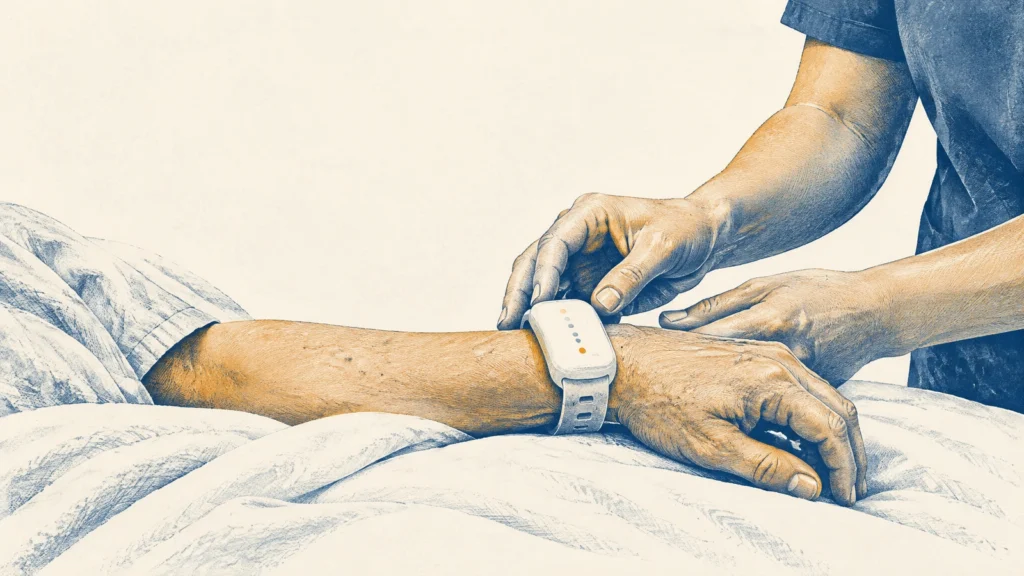
Scientific American reported one case at UC Davis Health, where a wearable vital-signs sensor frequently generated alerts that were difficult for nurses to interpret. “This is where it became really problematic,” said Melissa Beebe, a registered nurse who has worked there for 17 years. “It was vague” (Scientific American).
Michelle Gutierrez-Vo, whom MedPage Today identified as a charge nurse at Kaiser Permanente Fremont Medical Center and president of the California Nurses Association, told the outlet: “Just like there’s oversight for medications … when it comes to being used for patients, this is just as dangerous” (MedPage Today).
What to Ask For Before January
Under AB 1979, the clinical judgment duty takes effect Jan. 1, 2027 (Nurse.org). On this article’s reading, the practical question for a nurse is what her own employer has written down, and the advice runs to one email:
- Ask your unit manager or chief nursing officer, in writing, for the inventory of AI tools that inform clinical decisions on your unit.
- Request the facility’s policy on documenting an override in the same message.
- If that policy is silent on discipline after an override, note the silence and the date you asked.
For hospital leadership the same logic points the other way. On this article’s reading, a facility that has to show “reasonable steps” will be measured against whatever it wrote, so the override policy is worth drafting before the duty takes effect.
What Happens Next
Backers plan to try again. Lorena Gonzalez, president of the California Federation of Labor Unions, which co-sponsored the bill, said: “We are committed to bringing this bill back next year” (National Nurses United). Ortega said she “will keep fighting until every Californian has that protection” (National Nurses United).
Whatever is refiled will land on a different desk: Newsom’s term ends in January 2027 (Nurse.org).
For the federal side of medical AI oversight, see Medical AI Regulation: FDA’s 26 Questions on a Doctor-Style Exam. For who may eventually audit these systems, see California Writes AI Auditor Rules Before Any Audit Is Required.