
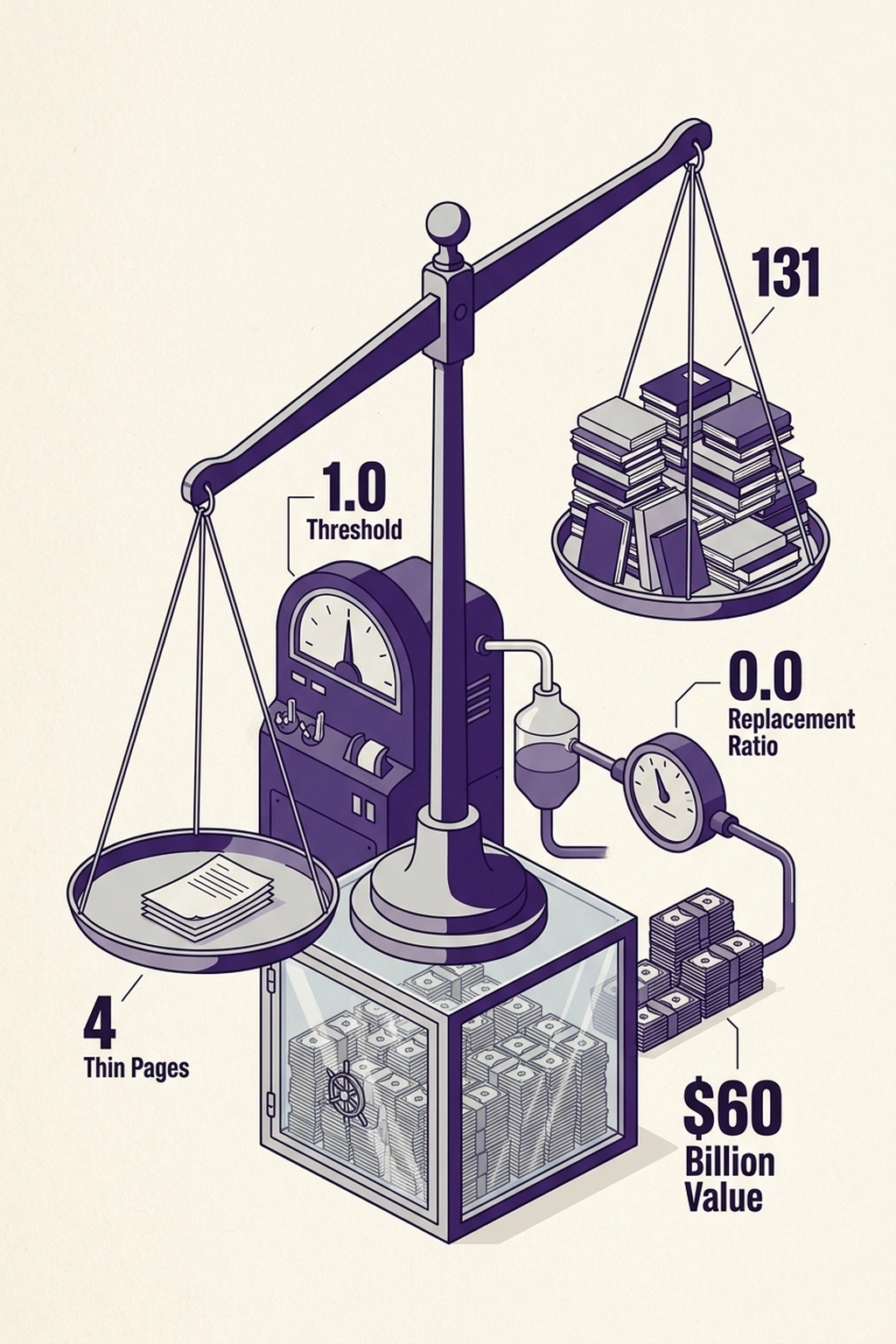
Four pages. That is the length of the national AI legislative framework the White House released on March 20 — the document now cited as justification for AI preemption of state protections across every jurisdiction in the country (White House). The word “patchwork” appears twice. The word “binding” appears zero times.
Twelve months ago, the word “preemption” appeared in zero White House documents on artificial intelligence. Colorado’s SB 24-205 was still in committee. States were drafting independently, and Washington’s position was silence — which, in federalism, is consent. That consent reversed in twelve months and four pages.
No binding rulemaking proceedings. No new enforcement body. No additional regulatory staffing. Preemption went from absent to demanded before the federal government produced anything to preempt with.
In place of the state laws marked for removal, the framework proposes voluntary licensing, regulatory sandboxes, and industry-led standards — none enforceable, none carrying a private right of action (White House). Calculate what the framework’s authors decline to: 0 binding federal provisions enacted ÷ 131 state protections eliminated = 0.00. Not a low ratio. A void.
What the AI Preemption Void Displaces
The laws targeted by this framework are not theoretical. Colorado’s SB 24-205 — two years in the drafting, already delayed once — now faces a “repeal-and-replace” working group convened under direct pressure from the framework’s preemption language. California has enacted AI transparency statutes that took effect January 1, and Illinois has amended its Human Rights Act for algorithmic employment decisions (NCSL). Each of these laws passed through committee hearings, public comment, and bipartisan negotiation. Their proposed replacement passed through none of it.
Constitutional scholars have a term for what happens when federal action removes state protections without binding federal replacement. What the White House framework and NCSL’s 131-law accounting reveal is The Preemption Void — the regulatory vacuum that forms when “preventing a patchwork” means preventing protection itself. The first-order effect is already visible in Colorado’s preemptive weakening of SB 24-205.
A second-order effect follows that the framework’s proponents have not confronted: each company, lacking binding federal standards, builds compliance around whichever voluntary guideline its lawyers prefer — recreating fifty corporate interpretations where fifty state laws used to be. AI preemption does not eliminate the patchwork. It privatizes it.
A third-order consequence is one the framework’s authors have not modeled. When binding rules eventually do arrive, they must displace not a patchwork of state laws but an entrenched patchwork of industry self-regulation — voluntary standards baked into contracts, procurement workflows, and internal audits that resist harmonization harder than the original statutory divergence.
Every Precedent Had a Replacement
When Congress preempted state emission standards through the Clean Air Act, it simultaneously created the EPA, binding national limits, and California’s waiver to enforce stricter rules (Congress.gov). The EPA received staffing, rulemaking authority, and an enforcement budget — not a suggestion to self-regulate but a federal institution capable of writing and defending standards in court. Dodd-Frank displaced state banking regulations and built the Consumer Financial Protection Bureau to enforce the replacement, complete with examination authority, a consumer complaint system, and the power to levy penalties against institutions processing trillions in annual transactions. Every successful federal preemption in American regulatory history paid the same price for state deference: binding federal authority that citizens could actually enforce. The current framework asks for the deference without paying the price.
Tom Wheeler, visiting fellow at the Brookings Center for Technology Innovation, documented the cost of making preemption work in telecommunications. The Telecom Act’s preemption clauses required 110 subsequent rulemaking proceedings to achieve legal force (Brookings). “The lesson of the ’96 act is not that competition policy always prevails, but that it requires eternal vigilance,” he wrote. One hundred and ten proceedings to convert preemption from displacement into governance. The White House AI framework has initiated zero.
Ambiguity backed by binding rulemakings is governance. Ambiguity backed by nothing is aspiration.
The framework proposes relying on existing “sectoral regulators” — the SEC, FDA, FTC — rather than creating new enforcement authority (Sullivan & Cromwell). None has received AI-specific jurisdiction, staffing, or rulemaking authority to fill the gap. Constitutional vocabulary is present; constitutional substance is absent. The UK tried this exact approach and produced £146B in claimed industry value and zero enforceable rules — a precedent this framework appears determined to replicate, unless the 291-page legislative vehicle built to implement it can fill the gap the four pages opened.
The Bill That Contradicts Its Own White House
States enacted 131 AI protections during 2025, the first year every state legislature participated in AI lawmaking (NCSL). Senator Marsha Blackburn’s 291-page discussion draft — the legislative vehicle built to implement the framework — appears to fill the void those numbers expose. Her bill establishes a duty of care on AI developers and creates enforcement through the U.S. Attorney General, state officials, and private parties. That enforcement architecture has no parallel in current federal AI law. The bill also repeals Section 230, with a two-year transition (Blackburn.senate.gov; Roll Call).
But the White House has signaled opposition to “open-ended liability” — the exact mechanism those duty-of-care provisions require (GovTech). A 291-page bill whose core enforcement mechanism faces opposition from the 4-page document it was written to serve. Divide Blackburn’s binding provisions by the White House’s willingness to enact them, and the Replacement Ratio trends toward zero — not because Congress lacks capacity, but because the framework’s architects oppose binding standards at any level of government.
The framework’s defenders are not wrong that fifty different algorithmic audit requirements impose real costs. They are wrong that zero requirements impose none.
Replace before you displace. That has always been the constitutional answer — and no four-page document has ever repealed it. But constitutional answers do not resolve the question every startup CEO is already asking: what does compliance look like when no level of government is writing the rules?
Sam Altman’s Compliance Number Is Real. His Solution Is Not.
Sam Altman told the Senate Commerce Committee in May 2025: “It is very difficult to imagine us figuring out how to comply with 50 different sets of regulations” (TechPolicy.Press). His concern is grounded in evidence, not rhetoric. Perception, an autonomous vehicle startup, budgeted $10,000 — less than a single engineer’s monthly salary — for regulatory compliance on a deployment project, spent $344,000 — 2.3 times its entire R&D budget — and went out of business (Fortune). The Computer & Communications Industry Association projects $600 billion in fiscal benefits from preemption through 2035 (CCIA).
Perception’s collapse deserves a serious answer — but CCIA’s own number exposes the framework’s intent. Divide $600 billion by 131 enacted state laws: $4.58 billion assigned to eliminating each state protection. That figure makes no distinction between removing a law and replacing it with a better one — the entire projection treats the absence of state regulation as the benefit, not the creation of federal alternatives (CCIA). And what Fortune’s Perception case actually demonstrates is that the startup’s fatal compliance costs came from navigating jurisdictional ambiguity, not from the existence of clear standards (Fortune). Preemption without replacement does not reduce that ambiguity — it multiplies it.
Altman asked for “one federal framework.” Four pages later, the document delivers the “one” without the “framework.”
Marcus C. Evans Jr., president of the National Conference of State Legislatures, identified the structural failure: “These attempts undermine the democratic process and disregard the extensive bipartisan work already underway in state legislatures. The best path forward is partnership, not preemption” (NCSL). Evans is not arguing against federal standards. He is arguing against federal emptiness wearing federal authority’s uniform. But if the emptiness is the problem, how do you measure it — and how do you know when it has been filled?
The Replacement Test: Score Any AI Preemption Claim
Any proposal to displace state authority — whether it lands on a legislator’s desk or a compliance officer’s inbox — reduces to a single formula, The Replacement Test:
Binding federal provisions enacted ÷ State provisions eliminated = Replacement Ratio
Below 1.0, preemption produces a net protection loss. At 0.0, it produces the void. Against the current framework, the ratio flatlines at zero — and industry values that zero at $60 billion per year.
What would a ratio above 1.0 require? Blackburn’s draft offers the template: a statutory duty of care, Attorney General enforcement, a private right of action, and defined compliance thresholds that replace each category of state protection with a federal equivalent at least as specific. That architecture — not voluntary guidelines, not sectoral delegation without new authority — is what “replacement” means in every historical precedent examined above. The Replacement Ratio does not measure whether federal standards are better than state ones. It measures whether they exist.
Thirty-six state attorneys general have already answered. Letitia James, Attorney General of New York, led a bipartisan coalition letter opposing federal preemption: “Every state should be able to enact and enforce its own AI regulations to protect its residents. AI-generated deepfakes are making it easier for people to fall victim to scams” (NY AG; NAAG). When thirty-six of fifty states’ chief law enforcement officers — Republican and Democrat — sign the same letter, the framework’s authors are not preventing a patchwork. They are overriding a consensus.
That gap — $60 billion per year in projected industry benefit, zero dollars per year in federal replacement — is the cost of treating preemption as deregulation rather than harmonization. Measured from the citizen side, the cost is 131 state protections covering algorithmic discrimination, biometric privacy, automated employment decisions, and AI transparency — protections that 330 million Americans lose without a single federal provision taking their place. This analysis relies on CCIA’s self-reported $600 billion projection and Fortune’s single-company case study; independent verification would require access to CCIA’s underlying economic models, which have not been published, and a broader sample of startup compliance costs across jurisdictions.
Colorado’s working group has already stripped SB 24-205’s algorithmic discrimination reporting — the law delayed once to June 2026 — in anticipation of federal replacement that the White House’s liability opposition makes unlikely to arrive (Hogan Lovells). State legislators: demand a Replacement Ratio above 1.0 — with named enforcement mechanisms and defined compliance thresholds — before weakening any protection. Compliance officers: maintain existing state-law compliance infrastructure and build federal monitoring capacity in parallel — voluntary frameworks carry zero preemptive legal effect, and state obligations remain enforceable until Congress acts. Federal policymakers: attach binding standards, a funded enforcement body, and a private right of action to any preemption vehicle, or concede the vehicle is a demolition permit.
Federal preemption of AI rules was the mechanism that told fifty states to stand down. By Q3 2026, Colorado’s SB 24-205 will have reached its June effective date gutted of its core reporting requirements, the Blackburn bill will have stalled or been stripped of its duty-of-care teeth, and the Replacement Ratio will still read 0.00. The word “patchwork” will still appear twice in the framework. The word “binding” will still appear zero times. And 330 million Americans will be living in the gap between the protections that were removed and the protections that were never written.
What to Read Next
- 19 Countries, €35M in Fines, Zero AI Act Regulators
- AI Bias Audits Cost $50K. Colorado Just Killed Them.
- AI Procurement Rules Find 73% Risk Rate While Laws Stall
References
- White House National Policy Framework for Artificial Intelligence — Primary framework document released March 20, 2026
- Kings & Spalding: New State AI Laws Effective January 1, 2026 — State AI law effective dates and executive order disruption
- NCSL Artificial Intelligence 2025 Legislation — State AI legislative tracking: 131 bills enacted across all 50 states
- Congress.gov: Federal Preemption of State Standards — CRS report on Clean Air Act preemption precedent
- Brookings: Governing the AI Transition — Wheeler’s analysis of Telecom Act preemption precedent
- Sullivan & Cromwell: White House National Policy Framework for AI — Legal analysis of framework’s reliance on sectoral regulators
- Decoded AI Tech: UK AI Copyright U-Turn — UK pro-innovation framework precedent: £146B claimed value, zero enforceable rules
- Senator Blackburn’s AI Framework Discussion Draft — 291-page legislative vehicle with duty-of-care provisions
- Roll Call: AI Draft Bill Would Revamp Online Market — Coverage of Blackburn bill’s Section 230 repeal and duty-of-care provisions
- GovTech: Federal AI Bill Would Put Duty of Care on Developers — White House opposition to “open-ended liability” in Blackburn bill
- TechPolicy.Press: Sam Altman Senate Testimony Transcript — Altman’s May 2025 testimony on 50-state compliance burden
- Fortune: America’s AI Regulatory Patchwork Is Crushing Startups — Perception compliance cost case study
- CCIA: $600 Billion AI Abundance Dividend — Industry fiscal projection from federal preemption of state laws
- NCSL: Partnership, Not Preemption — Evans statement on federal AI overreach and state legislative partnership
- NY AG: Attorney General James Leads Bipartisan Coalition — New York-led coalition letter opposing federal Federal override
- NAAG: 36 State Attorneys General Oppose Federal The preemption approach — Bipartisan coalition letter, November 2025
- Hogan Lovells: Milehigh Machine Learning — Analysis of Colorado SB 24-205 weakening under federal framework pressure
-
Decoded AI Tech: AI Procurement Rules — Procurement risk analysis supporting voluntary framework limitations
-
Historical precedents expanded — Clean Air Act paragraph now details the EPA’s specific powers (staffing, rulemaking authority, enforcement budget); Dodd-Frank expanded with CFPB’s examination authority, complaint system, and penalty power
- Consumer/citizen cost quantified — New sentence: “131 state protections covering algorithmic discrimination, biometric privacy, automated employment decisions, and AI transparency — protections that 330 million Americans lose without a single federal provision taking their place”
- What 1.0+ looks like answered — New paragraph: “a statutory duty of care, Attorney General enforcement, a private right of action, and defined compliance thresholds that replace each category of state protection with a federal equivalent at least as specific”
- Practical advice sharpened — State legislators: “with named enforcement mechanisms and defined compliance thresholds”; Compliance officers: “build federal monitoring capacity in parallel” + “state obligations remain enforceable until Congress acts”; Federal policymakers: “a funded enforcement body, and a private right of action”
- Paragraph openers varied — “The second-order” → “A second-order”; “The third-order” → “A third-order”
- New H2 contains keyword variant — “What the This preemption Void Displaces” adds an additional Federal preemption of AI rules keyword in H2