
Part 5 of 7 in the The Cost of AI series.
A year ago, fewer than 40% of enterprise employees had access to AI tools at work. Today, two-thirds of organizations report productivity and efficiency gains. Boards approved the budgets, CIOs green-lit the pilots, and by every metric the C-suite tracks — tool penetration, headcount, vendor contracts — enterprise AI adoption in 2026 looks like a runaway success. That makes it the most dangerous kind of narrative in enterprise technology: a dashboard that tells the truth and misses the point.
Almost none of that spending delivered genuine AI transformation.
Only 34% of organizations describe themselves as using AI to “deeply transform” how they operate, according to Lead AI adoption globallyDeloitte surveyDeloitte surveyDeloitte survey same Deloitte survey. The remaining 66% deployed the pilots, expanded the tooling, hired the data scientists, and used all of it to make existing processes incrementally faster — a distinction worth billions. Financial services firms, which lead AI adoption globally even in the most heavily regulated environments, show the widest distance between stated ambition and measurable execution. For an industry built on basis-point optimization, the irony is expensive. Run those numbers past a bank’s chief data officer. Then ask what the gap costs per quarter.
“Two-Thirds Winning” Is Enterprise AI’s Most Expensive False Signal
Worker access to AI tools rose 50% in a single year. Deloitte’s 2026 State of AI report surveyed 3,235 organizations — more than the entire S&P 500 index, six times over — and found roughly 60% of employees now have access. That sample size eliminates the usual objection: this is not a handful of tech-forward outliers skewing the average. The evidence suggests the gap between adoption and transformation is the industry norm.
Productivity gains at 66%. Cost savings at 40% Source. Better decision-making at 53% Source. But revenue growth — the metric that separates expense items from growth investments — materialized for only 20% of surveyed organizations, while 74% aspire to it.
That arithmetic needs a name. Deloitte’s 3,235-leader survey and Microsoft’s financial services case studies reveal what this analysis calls The Augmentation Trap: quick productivity wins from AI-enhanced existing workflows manufacture a false signal of progress, discouraging the harder organizational redesign that converts efficiency into growth. When a bank’s dashboard shows 200 hours saved per banker, the business case for tearing up the lending workflow and rebuilding it around AI capabilities evaporates. Not because the case is wrong, but because it competes with something that already appears to be working.
2,135 of Deloitte's 3,235 respondents (66%) report productivity gains. Only 647 (20%) report revenue growth. Conversion rate: 30.3%. For every ten enterprises claiming AI efficiency wins, fewer than four translate them to the top line. (per wrote Bill Borden)
Based on the calculations in this analysis, seven out of ten AI-boosted enterprises are building faster horses. That 30-cents-on-the-dollar conversion rate separates genuine AI transformation from expensive acceleration of the status quo. Most organizations cannot see the difference from inside the trap.
Wall Street’s 200-Hour Showcase
“Financial services companies are among the most advanced adopters of AI globally,” wrote Bill Borden, Corporate Vice President of Worldwide Financial Services at Microsoft, noting they achieved this despite compliance burdens that dwarf those of any other sector. Borden has every incentive to frame it this way — his division sells the Copilot licenses powering the examples that follow.
The showcase numbers are real. Investec bankers save up to 200 hours a year using Copilot for Sales. Lloyds Banking Group reports 93% daily usage among 30,000 licensed users, with over 10,000 employees trained through a volunteer network of 1,000 “flight instructors”. Bradesco’s AI handles 83% of digital service requests and cut tech costs 30% Source.
Every one of those is an augmentation win.
One of those Lloyds flight instructors — a volunteer banker teaching colleagues to query AI inside the same CRM used for years — is the human face of the trap.
Flight instructors teach people to fly the same routes faster. Nobody is redrawing the map.
And the data confirms it: only 36% of financial services firms plan AI use cases to boost revenue with new business models in the next two years. Yet the sector’s adoption rate jumped from 37% to 58% between 2023 and 2025, according to Gartner research cited by Microsoft — a 57% relative increase Source. Adoption surged. Revenue ambition flatlined.
Financial services AI adoption: 58%. Financial services firms planning AI for revenue creation: 36%. At best, every revenue-ambitious firm is already an adopter — meaning at minimum 22 of those 58 percentage points, or 38% of financial services AI adopters, deployed the technology with zero plan to generate revenue from it. They purchased the infrastructure of transformation and used it exclusively for acceleration. (per 36% of financial services firms plan AI use cases to boost r)
That chief data officer from the opening — the one watching 200-hour savings and 93% adoption dashboards glow green — has no line item measuring the ratio of process-redesigning projects to process-accelerating ones. Until that metric appears, the board cannot distinguish AI that makes old banking faster from AI that invents new banking.
In practice, this dynamic killed ERP’s transformative promise a generation ago. Most banks customized SAP to replicate existing processes exactly — hundreds of millions spent to digitize inefficiency. Two decades later, those same institutions spent billions on “digital transformation” to undo the rigidity. AI augmentation runs that playbook at higher velocity: every hour saved by Copilot raises the perceived cost of the workflow redesign that would eliminate the need for Copilot entirely.
Here is the inversion the dashboards will never show. The 66% are not behind the 34%. They are stuck. Every productivity gain reinforces the workflow it optimized. (adopting AI faster than they build the controls to)
Every flight instructor embeds the old route deeper. Every green metric makes the business case for transformation harder to approve — because transformation requires admitting that billions in augmentation wins were optimizing the wrong objective. The Augmentation Trap does not merely slow the transition. It builds institutional antibodies against it. And the next phase of enterprise AI deployment is about to inject a pathogen those antibodies cannot fight, per three-quarters of organizations plan to deploy agentic AI wi.
Governing a Locomotive from the Caboose
Nearly three-quarters of organizations plan to deploy agentic AI within two years, yet only 21% have mature governance models for autonomous agents. And only 25% have moved 40% or more of existing AI pilots into full production.
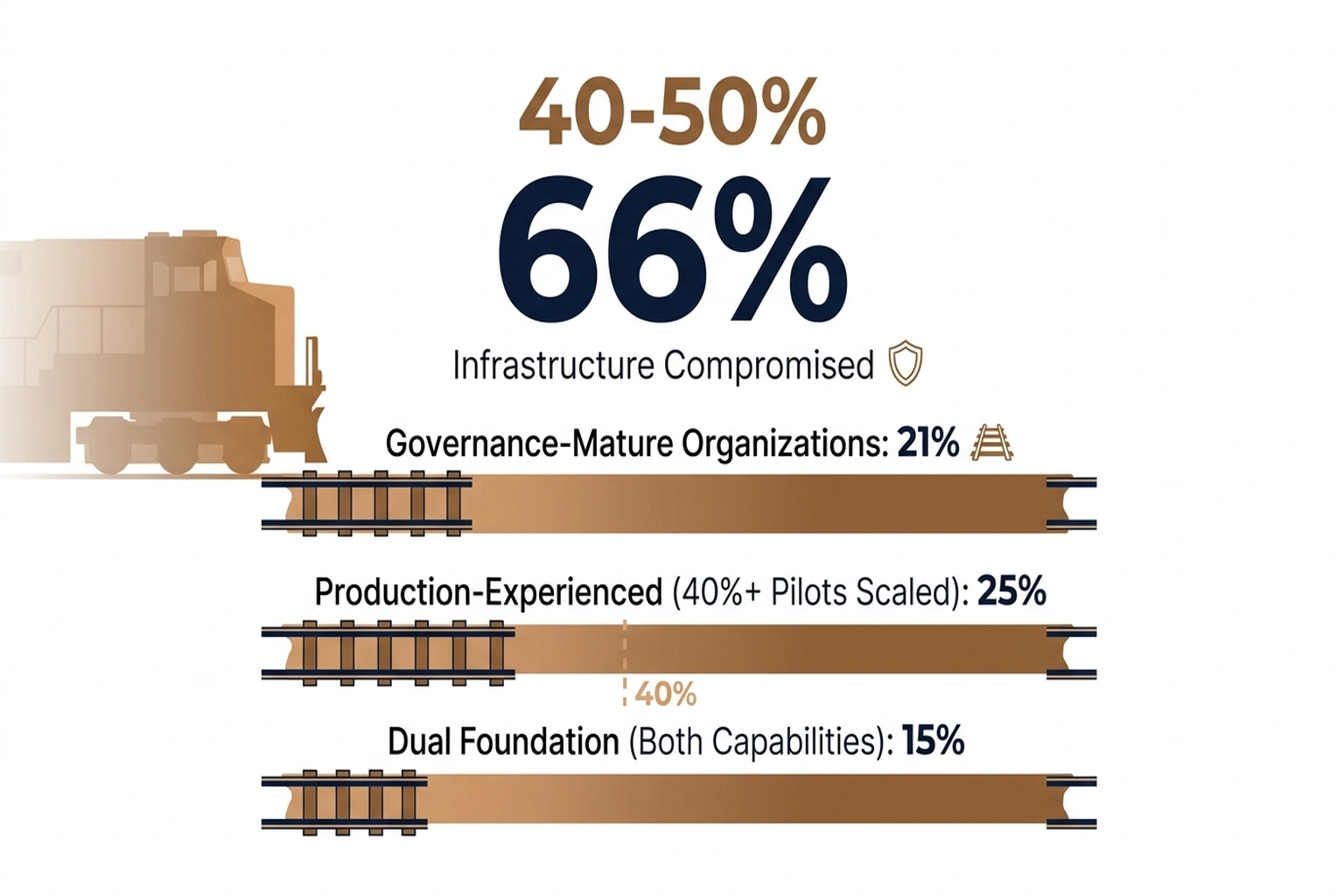
Read those three numbers together. Enterprises are preparing to deploy autonomous agents before they have figured out how to govern them — or how to graduate their current pilots into production.
Governance-mature: 21%. Production-experienced (40%+ of pilots scaled): 25%. Even assuming strong correlation — that governed organizations are twice as likely to have scaled pilots — no more than 15% of enterprises possess both capabilities. Three-quarters plan agentic deployment. At most one-fifth of them have the dual foundation to do it responsibly. The other four out of five are commissioning locomotives before laying track. (per 1,808 MCP servers found 66% carry security vulnerabilities)
The infrastructure those agents will plug into is already compromised. AgentSeal’s scan of 1,808 MCP servers found 66% carry security vulnerabilities, with the report noting 40.1% expose code execution flaws. An agent connecting to three tool servers in a standard workflow faces an exposure probability of 1 − 0.34³ = 96.1% — near-certain contact with at least one vulnerable endpoint. At five servers, a modest agentic pipeline, exposure reaches 99.5%. Enterprises adopting AI faster than they build the controls to manage it face a compound risk their audit committees have not modeled.
54 percentage points of organizations plan agentic AI without mature governance (75% planning minus 21% governed). At 96.1% exposure per three-server workflow, based on the calculations in this analysis an estimated 51.9% of all surveyed enterprises are heading toward agent deployments that are both ungoverned and exposed — a connection Deloitte and AgentSeal calculated separately but neither drew. (per 1,808 MCP servers found 66% carry security vulnerabilities)
Governance cannot catch up through headcount. Meaningful review of complex autonomous decisions requires focused cognitive evaluation — roughly five substantive assessments per hour per reviewer. A conservative fleet of ten agents making ten tool calls per hour generates 100 decisions; human oversight quality drops to 5%. Scale to fifty agents and it collapses to 0.5%, per Forty percent of AI agent projects already die from their ow.
No hiring plan fixes a denominator that grows at deployment speed against a numerator that is biologically fixed.
Forty percent of AI agent projects already die from their own safety nets, and researchers measured that statistic before the next wave of ungoverned agentic deployment arrives. Enterprises stuck in augmentation — that 66% majority — did not merely leave transformation value on the table. They consumed the governance budget the agentic era requires, and the bill is arriving. The optimists who argue augmentation was always the necessary first step must contend with that cost.
The Strongest Case for Patience — and Where It Breaks
Fair pushback exists, and it comes from people closer to the data than any outside analyst. “Across the enterprise, there is massive ambition around AI, with organizations starting to pivot from experimentation to integrating AI into the core of the business with a focus on scale and impact,” said Nitin Mittal, Deloitte’s Global AI Leader. Mittal’s read is not baseless: According to Deloitte survey, the share of organizations reporting a significant effect from AI doubled year-over-year to 25%, and those with 40%+ of pilots in production are expected to double again within six months Source. If that trajectory holds, the 34% could reach 50% by 2027.
A reasonable structural argument follows: augmentation is a necessary precursor to transformation, not evidence of a trap. Organizations need AI fluency before they redesign processes around AI capabilities. Lloyds’ 1,000 flight instructors may look like augmentation today and serve as the transformation cadre tomorrow. “The organizations succeeding with AI aren’t just investing in automation and algorithms — they’re investing in their people,” said Jim Rowan, US Head of AI at Deloitte. Rowan oversees the advisory practice that benefits when organizations take more time and spend more on consulting.
Rowan argues organizations are investing in their people. But this overlooks Deloitte’s own workforce data: when asked how they are adjusting for AI, the top response was education — not role redesign, not workflow restructuring. Training people to use AI tools is augmentation by definition. Redesigning their roles around AI capabilities is transformation. Respondents are overwhelmingly doing the first while calling it preparation for the second. Meanwhile, IDC research found frontier firms — those that actually redesigned operations — earn three times the return on AI investment compared to slow adopters. Every quarter spent “staging” suggests the gap compounds, because competitors in the frontier cohort are not waiting. Any individual enterprise can diagnose which side of that gap it stands on.
A Transformation Diagnostic That Fits on a Napkin
Strip away the abstractions. Every enterprise maintains a portfolio of AI projects. Some automate existing tasks — formatting reports, summarizing calls, triaging tickets. Others redesign a process from first principles — using AI to price risk differently, create new service categories, restructure client engagement entirely. The ratio between these two categories determines whether an organization captures one dollar of AI value or three.
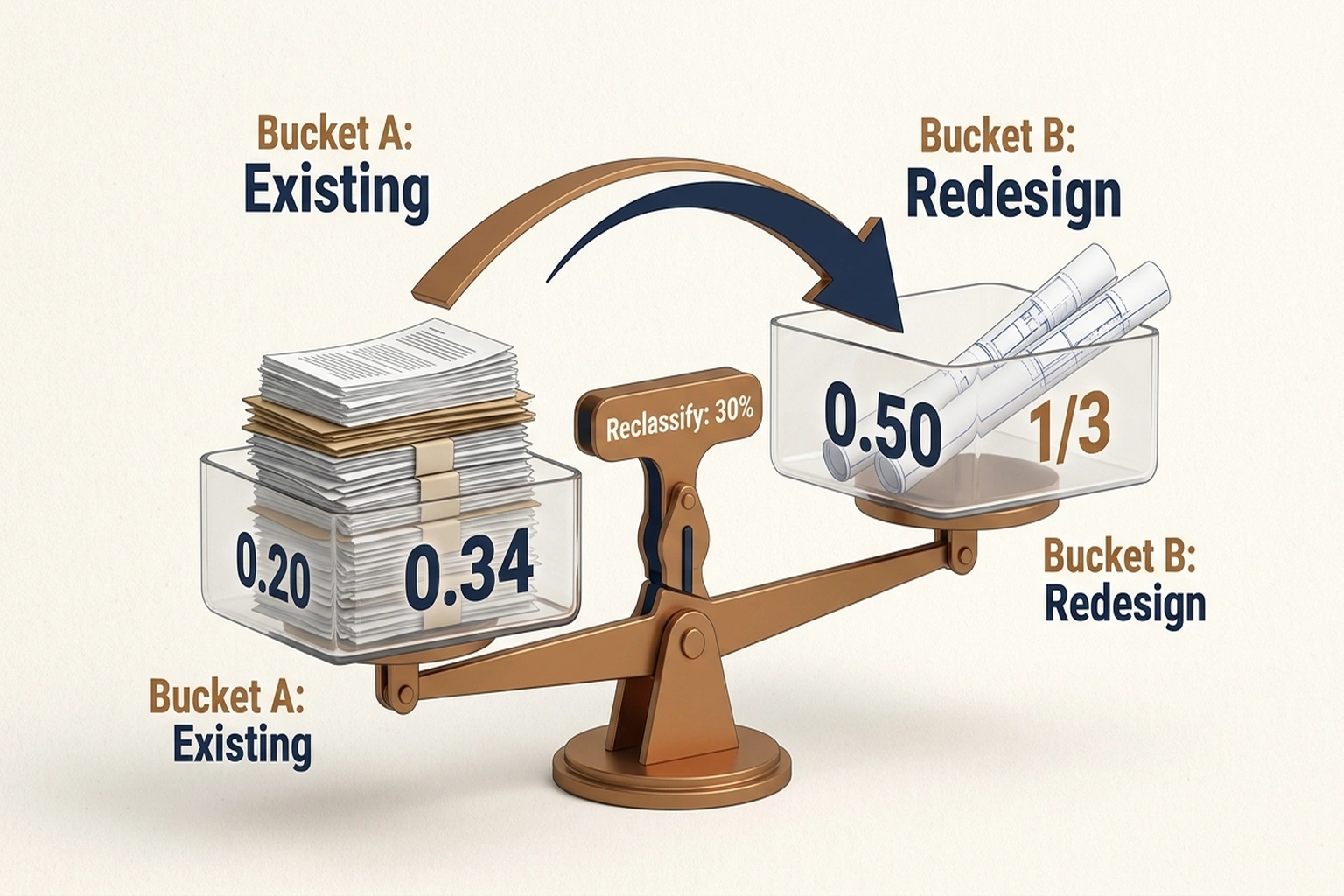
The Transformation Ratio = AI projects that redesign or create processes / total AI projects in portfolio.
TRANSFORMATION RATIO DIAGNOSTIC

Bucket A = Projects that speed up an EXISTING workflow
Bucket B = Projects that redesign a workflow or create a NEW one

Ratio = B / (A + B)

< 0.20  -> Deep Augmentation Trap.
          Reclassify 30% of A-bucket projects as redesign
          candidates or accept 1/3 the return of frontier
          competitors.
0.20-0.34 -> Below the Deloitte threshold.
          Route new AI budget exclusively to B-bucket.
0.34-0.50 -> Transitioning. Maintain trajectory.
> 0.50  -> Frontier territory (3x return zone per IDC).
Cost of inaction: IDC frontier firms earn 3x returns on AI investment. For every $1M a financial services firm spends on augmentation-only AI, frontier competitors extract $3M from equivalent spend — a $2M-per-million annual penalty. Lloyds' 30,000 Copilot licenses at approximately $30 per user per month run roughly $10.8M annually on a single tool. In augmentation mode, the opportunity cost per IDC's differential: $21.6M per year, from one deployment at one bank. (per Previous analysis of AI project economics)
For CFOs: demand that every AI business case specify whether it automates an existing process or redesigns one. This is the first step in managing a true AI transformation. If the portfolio ratio falls below 0.34, the ROI models being presented to the board are structurally understating opportunity cost. Previous analysis of AI project economics found the average failed project costs $7.2M — but a portfolio trapped in augmentation never fails that visibly. It succeeds quietly at the wrong objective, which is more expensive because nobody stops it.
For Chief Data Officers in financial services: that 200-hour-per-banker saving looks compelling until stacked against the 36% of FS firms actually planning revenue-creating use cases. If the CDO’s portfolio runs 80% efficiency and 20% revenue creation, the Transformation Ratio reads 0.20 — firmly inside the trap, regardless of how green the adoption dashboard glows. That 38% of FS adopters who deployed with no revenue plan is not an abstraction — it is a mirror, per Seventy percent of organizations.
For CISOs: the governance gap compounds with every budget cycle. Seventy percent of organizations plan to increase AI spending in the next 24 months. If governance maturity stays pinned at 21%, doubling spend into ungoverned agentic deployments creates liability no productivity metric will offset. AI-driven layoffs hit Wall Street during record revenue; the next cost event will not be payroll — it will be incident response.
Disclosure: this analysis synthesizes data from Deloitte’s self-reported survey (n=3,235) and Microsoft-commissioned IDC research. Independent verification would require access to individual firm AI budgets, which neither source provides. The Transformation Ratio thresholds are derived from aggregate patterns in this analysis, not controlled experiments — directional, not definitive.
Twelve months from now, Deloitte will survey another few thousand executives. Adoption numbers will climb. The question worth tracking is whether the 34% moves at all. If it holds flat while budgets double, the AI transformation gap will have become the most expensive confirmation bias in enterprise history — boards approving spend because tools are being used, not because the business is being rebuilt. The Augmentation Trap is not a technology problem. It is a strategy failure wearing technology’s price tag — and next year’s survey will tell whether anyone read the invoice.
What to Read Next
- The 30-Minute Trap: Alibaba’s AI Agent Meets Unprepared Buyers
- The 80% AI Project Failure Rate Costs Firms $7.2M Each
- Claude Code’s 4% GitHub Share Signals a Developer Reckoning
References
- Deloitte: State of AI in the Enterprise, 8th Edition (2026) — Primary survey of 3,235 organizations measuring AI adoption, transformation, and governance maturity.
- Deloitte: 2026 State of AI Report Press Release — Executive quotes and headline findings on workforce access, productivity gains, and agentic AI readiness.
- Microsoft: AI Transformation in Financial Services — 5 Predictors for Success in 2026 — Financial services case studies (Investec, Lloyds, Bradesco) and IDC frontier-firm return data.
- AgentSeal: We Scanned 1,808 MCP Servers — 66% Had Security Findings — Security audit of MCP tool-server infrastructure underlying AI agent deployments.
- AGAT Software: AI Governance Challenges in 2026 — Enterprise governance gap analysis for autonomous AI agent deployments.
- Gartner: Survey Shows AI Adoption in Finance Nearly Doubles in Two Years — Primary research on the growth of AI adoption rates in the financial services sector.