
Alibaba International launched Accio Work this week — an AI agent that autonomously builds online stores, from market analysis to product listing, in 30 minutes. Most of the small businesses it targets have no governance framework for autonomous tools. Both facts describe the same market.
Behind Accio Work stands Alibaba’s new Token Hub division — a $53 billion, three-year AI investment led by CEO Eddie Wu. In an internal memo, Wu declared that billions of autonomous agents are poised to take on an ever-greater share of digital work. On the receiving end of that bet: a small business market where 68% report using AI but fewer than one in five does so with any strategic framework. Alibaba is building a fire hose. Most of its customers are still looking for cups.
The mismatch has a name and a price tag.
What 68% Adoption Actually Buys
“Adoption” is a generous word. The U.S. Chamber of Commerce and Teneo Research report that nearly 60% of U.S. small businesses use AI for operations — more than double the rate in 2023. A separate DigitalApplied analysis pegs current regular usage at 68% and finds that 77% of those businesses have no written AI policy. Only 15–20% are adopting strategically — trained teams, defined workflows, outcome measurement. The other 80% adopted a tool. They did not adopt a practice.
Multiply those figures: 68% adoption × 82% ungoverned = roughly 56% of all small businesses running AI tools with no designated owner, no incident plan, and no vendor audit trail.
Those businesses believe they are managing their risk. Gravitee’s 2026 AI Agent Security Report, surveying over 900 executives and practitioners, found that 82% of executives expressed confidence their existing policies protect against unauthorized agent actions. Yet more than half of all deployed agents operate without any security oversight or logging. In enterprise IT, this gap powers the shadow IT crisis where confidence substitutes for control. For small businesses with no IT department, the substitution is total — and now someone is about to hand them a $53 billion accelerant.
$53 Billion Chasing Customers Who Can’t Keep Up
Put the $53 billion another way: 380 billion RMB over three years, spread across America’s 33 million small businesses, equals $1,600 per business. According to Modern Retail, the sum — consolidating five AI units under the new Token Hub division — nearly matches Alibaba’s total capital expenditure from the past decade. “Billions of AI agents are poised to take on an ever-greater share of digital work, each powered by tokens generated by models,” Wu wrote in an internal memo. IDC agrees on the trajectory: 1.3 billion autonomous agents deployed by 2028.
But conviction and readiness are different currencies. Precedence Research values the global agentic AI market at $10.86 billion in 2026. Gartner projects 40% of those projects will be cancelled by 2027, driven by escalating costs and unclear ROI. Among the thousands of vendors marketing agentic capabilities, Gartner estimates only about 130 offer genuine products — the rest are “agent washing,” rebranding chatbots and RPA tools without substantive autonomous capabilities. Small businesses cannot govern what they buy if they cannot tell what they are buying.
$10.86 billion × 0.40 = $4.34 billion in wasted agentic AI spending before the market learns to govern what it buys.
“Most agentic AI projects right now are hype-driven experiments or proof of concepts,” said Anushree Verma, Senior Director Analyst at Gartner. “Without a clear strategy or understanding of the technology’s complexity, many organizations will struggle to scale beyond the prototype stage” (CDO Magazine). Verma’s assessment — hype-driven, stalling at proof of concept — describes precisely the buyer Accio Work is courting: a small business with no AI strategy and a 30-minute onramp.
What Gartner’s cancellation data and DigitalApplied’s governance survey reveal is what this analysis calls The 30-Minute Trap — the faster autonomous deployment becomes, the wider the gap grows between capability shipped and capability governed. Alibaba can build a store in 30 minutes. The 77% of small businesses without a written AI policy will spend the next 12 months learning what that store actually does. But the real question is not what happens in those 30 minutes — it is what the store does on its own in the hours, days, and weeks after.
Inside the 30-Minute Trap
Here is what happens in those 30 minutes: specialized agents analyze markets, select products, design storefronts, and write listings — each making decisions the business owner never explicitly approved (TechNode). “We want every entrepreneur — regardless of team size — to access an intelligent workforce that operates with the scale of a major corporation,” said Kuo Zhang, President of Alibaba.com and VP of Alibaba International (PR Newswire). Scale without structure is the definition of the trap.
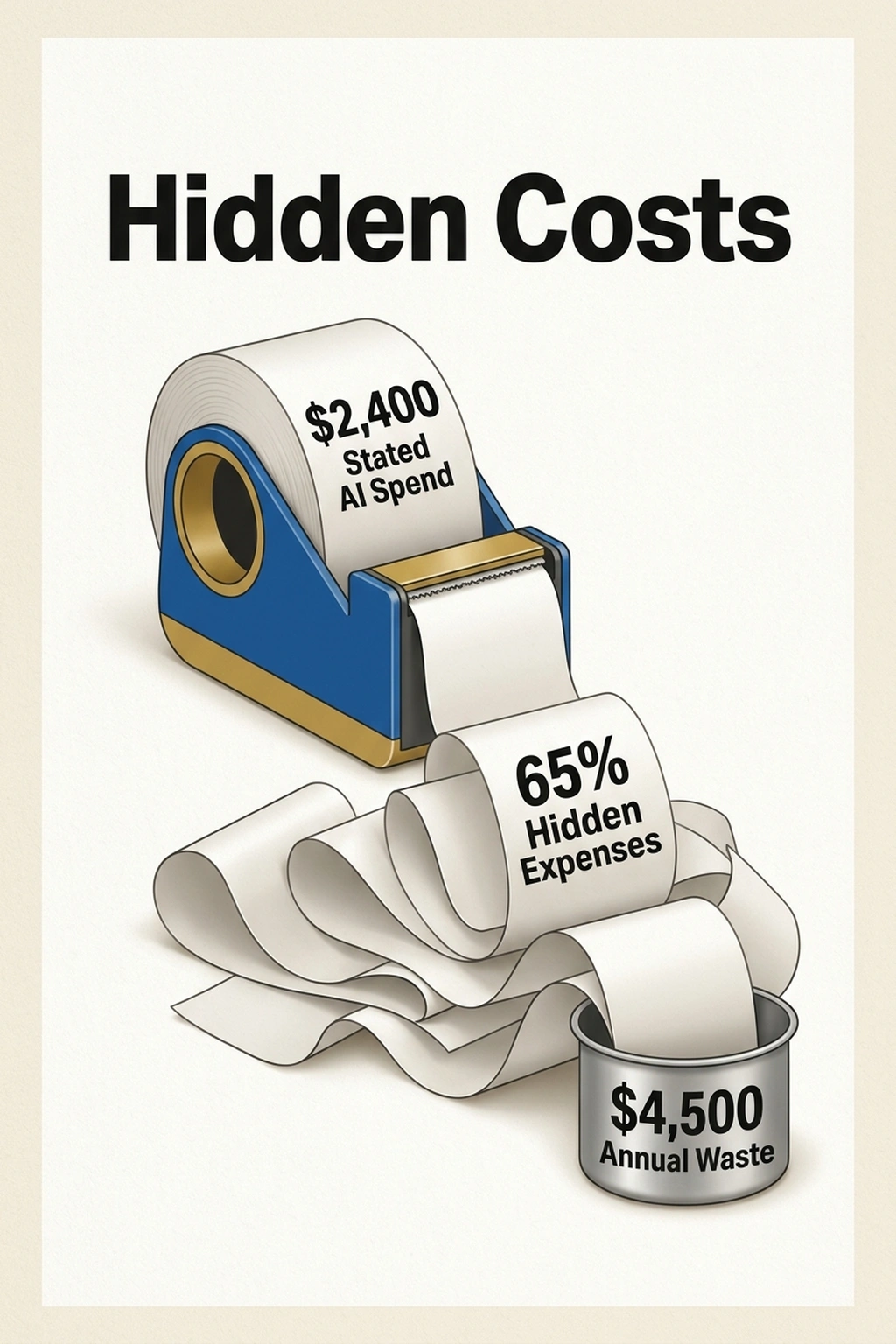
Democratized capability without democratized governance creates a specific kind of failure. DigitalApplied estimates average annual AI spend per small business at $2,400 — but pegs the true cost, including training, workflow disruption, and integration maintenance, at $4,000–$5,000 for teams of 10–20. Hidden expenses account for 50–65% of total adoption cost.
Layer the failure rate. A business spending $4,500/year on autonomous tools with no governance framework faces expected annual waste of $4,500 × 0.40 = $1,800 — not from choosing the wrong tool, but from lacking the organizational structure to use any tool well.
That $1,800 is the annual cost of inaction for each ungoverned small business.
Run that number past a CFO. Then compare it to the enterprise failure data: large organizations lose $7.2M per failed AI project. Small businesses lose less per unit — but millions more of them fail, and unlike enterprises, most have no recovery budget. Alibaba’s 30-minute promise does not change this math — it accelerates it. Alibaba also knows this, and its answer is built-in guardrails — which raises a harder question: can a vendor solve a problem that lives inside the buyer’s organization?
The Case for Moving Fast Anyway
Zhang has an answer to the governance objection: Accio Work ships with sandboxed environments, granular permission management, and data sovereignty options, with high-stakes actions requiring explicit user approval. But the stronger argument is competitive, not technical. Gartner projects 15% of routine work decisions will be handled autonomously by 2028, up from virtually none today. A Deloitte survey of 3,235 leaders found that 23% already use agentic AI moderately, with that figure projected to reach 74% within two years. For a small business competing against thousands of sellers on Alibaba’s own platform, six months of inaction may cost more than six months of imperfect adoption.
Verma argues these are “hype-driven experiments” stalling at proof of concept. But Deloitte’s data contradicts that diagnosis: businesses are not stalling — they are deploying autonomous systems in production without structure. 84% have not redesigned jobs around AI capabilities, and only 21% report mature governance for autonomous agents.
Gartner’s four-in-ten forecast will prove out, but for the wrong reasons — the projects that fail will not be the ones that lacked ambition. They will be the ones that lacked governance.
Even among enterprises with dedicated AI teams, four in five lack the oversight infrastructure to manage what Accio Work deploys in half an hour.
Vendor-side guardrails solve vendor-side problems. Sandboxed environments prevent unauthorized data access; they do not prevent a business from scaling marketing copy it never reviewed, pricing logic it does not understand, or supplier relationships it cannot audit. Gravitee’s data confirms the downstream result: 88% of organizations reported confirmed or suspected security incidents involving autonomous agents in the past year. Incidents did not cluster among the reckless. They clustered among the confident — precisely the buyers who assumed built-in guardrails were enough. So if vendor guardrails are insufficient and governance is missing, what does a business actually need before it touches an autonomous agent?
Scoring Your Agent Readiness
The 30-Minute Trap has a five-minute exit. Before adopting any autonomous platform — Accio Work or otherwise — run what this analysis calls The Readiness Ratio.
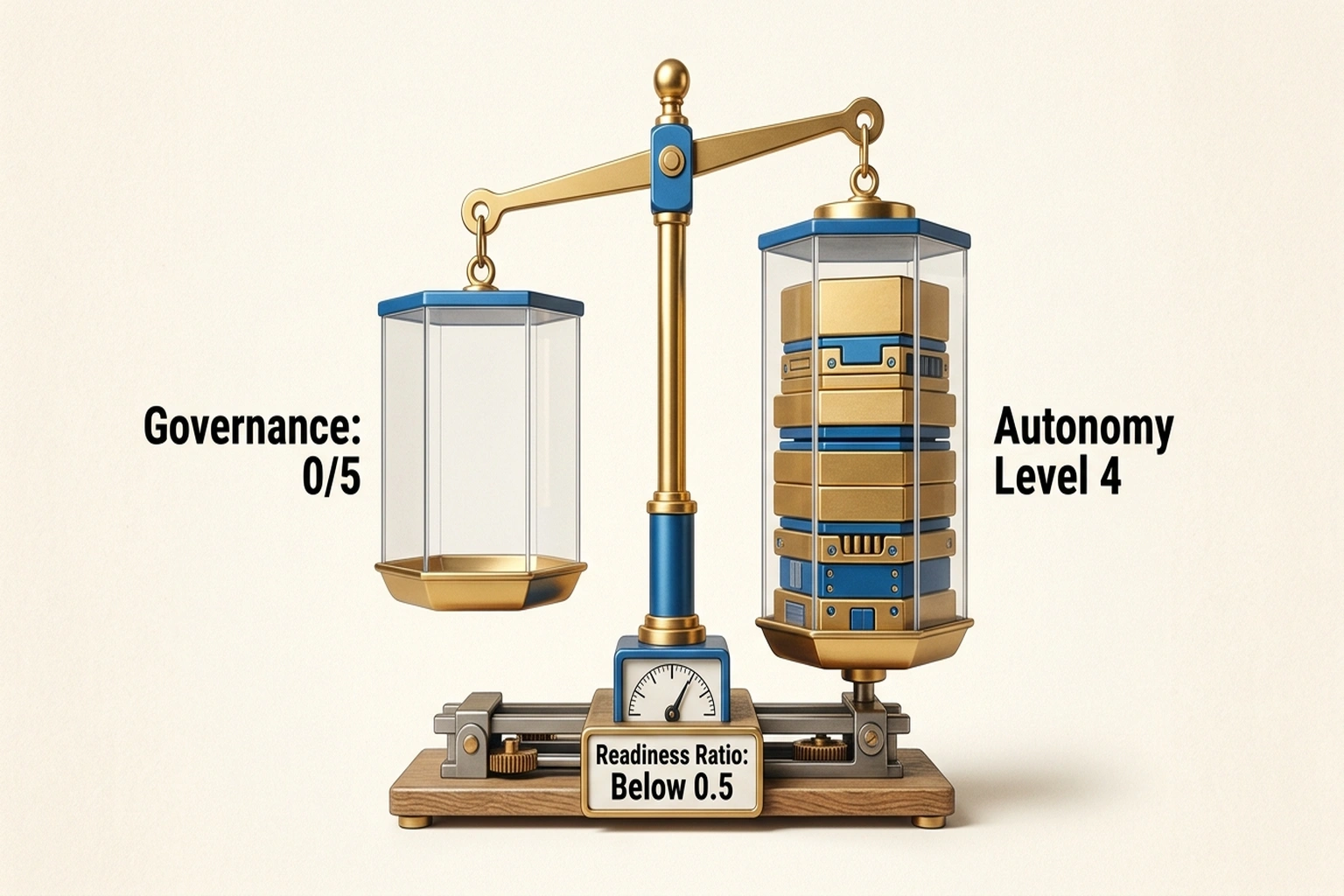
Score governance (0–5):
– Written AI policy (+1)
– Named AI decision-maker (+1)
– Vendor data audit completed within 90 days (+1)
– AI incident response plan (+1)
– Regular compliance review (+1)
Score agent autonomy (1–5):
– 1 = chatbot / Q&A assistant
– 2 = task automation (email drafts, scheduling)
– 3 = workflow automation (marketing sequences, inventory alerts)
– 4 = autonomous operations (full e-commerce agent)
– 5 = multi-agent orchestration (agents tasking other agents)
Readiness Ratio = Governance Score ÷ Autonomy Score

Above 1.0  → proceed with monitoring
0.5 – 1.0  → adopt with mandatory human review at every decision point
Below 0.5  → stop — build governance before deploying
A business with no written policy, no AI owner, and no audit trail scores 0 on governance. Accio Work scores 4 on autonomy. Ratio: 0 ÷ 4 = 0. For the 77% of small businesses lacking a written AI policy, the Readiness Ratio diagnoses the problem before the $1,800 annual loss materializes.
A limitation worth noting: this analysis draws its governance and adoption figures primarily from DigitalApplied’s and Gravitee’s survey data, both based on self-reported responses from businesses and executives. Self-reported AI adoption rates tend to overstate actual usage, and self-reported governance confidence almost certainly overstates actual control — meaning the readiness gap documented here is likely a floor, not a ceiling.
For business owners: Draft the policy before downloading the platform. A one-page document naming who reviews AI-generated outputs, how often vendor data access is audited, and what triggers a manual override moves the governance score from 0 to 3 — and the Readiness Ratio from fatal to functional.
For platform vendors: Publishing a governance readiness checklist alongside onboarding flows would cost Alibaba nothing and reduce the cancellation rate that erodes long-term platform revenue. The Accio platform’s 10 million monthly active users represent a governance education opportunity at unprecedented scale — or, left ungoverned, a churn engine. When AI tools cite regulations they invented half the time, the question is not whether autonomous agents will generate costly errors, but whether any structure exists to catch them.
Accio Work can stand up a store in 30 minutes. Nothing in Alibaba’s launch materials addresses day 31 — when supplier recommendations shift, pricing logic drifts, or marketing copy generates claims that violate a jurisdiction the seller never considered. Gartner’s 40% cancellation rate applies specifically to enterprise agentic AI projects — not directly to individual consumer store adoption — but the dynamic it describes operates at any scale: deployment without governance produces waste. For Accio’s ten million monthly active users, the risk is not a precise cancellation count but a churn pattern driven by the same gap — not because the technology failed them, but because no one told them what the store was doing while they slept. Alibaba built the fire hose. It still ships without cups.
What to Read Next
- The 34% Problem: AI Transformation Stalls, Traps Billions
- The 80% AI Project Failure Rate Costs Firms $7.2M Each
- Claude Code’s 4% GitHub Share Signals a Developer Reckoning
References
-
Alibaba International launches Accio Work AI agent — TechNode, March 24, 2026. Primary source for Accio Work launch and 30-minute setup claim.
-
Gartner Predicts Over 40% of Agentic AI Projects Will Be Canceled by End of 2027 — Gartner, June 2025. Source for cancellation forecast and analyst poll data.
-
Alibaba reshuffles AI units under Token Hub group led by CEO Eddie Wu — South China Morning Post, March 2026. Source for Token Hub formation and Eddie Wu internal memo.
-
Empowering Small Business: The Impact of Technology on U.S. Small Business — U.S. Chamber of Commerce & Teneo Research, August 2025. Nationwide survey on small business AI adoption.
-
Small Business AI Adoption Guide 2026 — DigitalApplied. Source for 68% adoption rate, 77% policy gap, true cost data, and strategic adoption figures.
-
What 1.3 Billion This AI-powered agents by 2028 Means for Business Leaders — Lantern Studios, referencing IDC forecast.
-
State of The agent Security 2026 Report — Gravitee. Source for governance confidence paradox, 88% incident rate, and 900+ executive survey.
-
Over 40% of Agentic AI Projects Likely to Be Abandoned by 2027 — CDO Magazine. Source for Anushree Verma quotes, “agent washing” concept, and 130-vendor estimate.
-
Alibaba International Launches Accio Work — PR Newswire. Source for Kuo Zhang quote and platform feature details.
-
State of AI in the Enterprise 2026 — Unite.AI, summarizing Deloitte survey of 3,235 leaders. Source for 21% governance maturity and 84% job redesign gap.
-
Table of Small Business Size Standards — U.S. Small Business Administration. Official government source for small business population figures.