
Affiliate Disclosure: This article contains affiliate links. We may earn a commission if you purchase through these links, at no additional cost to you. This helps us continue publishing free content. See our full disclosure.
Part 3 of 7 in the The Cost of AI series.
Part 4 of 6 in the Benchmark Reality Checks series.
GPT-5.4 Mini vs Nano: Small Model Costs Hide a 33-Point Cliff
GPT-5.4 Nano scores 52.39% on Software Engineering Bench Pro. GPT-5.4 Mini scores 54.4% , a 2-point gap, barely distinguishable from noise, on the benchmark OpenAI highlights most prominently in its launch materials. At less than a third of Mini’s per-token price, the small model costs equation looks settled.
OpenAI published another benchmark on the same page. OS World measures real desktop navigation , multi-step, tool-using tasks that agentic workflows actually demand. Mini scores 72.1%. Nano scores 39%. Not a 2-point gap. A 33-point cliff.
Nobody calculated what that cliff costs. The results follow.
Where Coding Benchmarks Stop and Agentic Workloads Start
The gap isn’t about difficulty. It’s about compounding. Software Engineering Bench Pro asks one question and grades one answer , errors are isolated. OS World chains multiple steps together, and a misjudgment at step two poisons everything downstream. Nano doesn’t score 33 points lower because it’s 33% worse at reasoning. It scores 33 points lower because it loses the thread early, and every subsequent step amplifies the drift.
NVIDIA’s 2026 paper declared small language models “sufficiently powerful, inherently more suitable, and necessarily more economical” for agentic systems. Gartner reinforced the position, projecting that organizations will use task-specific SLMs “three times more than general-purpose LLMs by 2027”. NVIDIA sells the GPUs powering both cloud APIs and self-hosted deployments , declaring SLMs “sufficient” serves every customer segment simultaneously. But “sufficiently powerful” depends entirely on which benchmark gets cited, and NVIDIA’s paper cites none that require multi-step chaining. OpenAI’s own OS World data contradicts the blanket claim not marginally, but categorically: a model scoring 39% on multi-step desktop tasks doesn’t lose points on a leaderboard. It loses the thread one-third of the way through a five-step pipeline.
This is what practitioners call The Two-Point Trap , narrow, single-turn evaluations that manufacture false equivalences between models that diverge catastrophically the moment a task requires chaining. Every procurement decision built on a single benchmark falls into it , and discovers the 33-point cliff not as a test failure, but as a budget variance. The question is how much variance, and whether the savings that justified the selection survive the math.
What 3.75x Per-Token Savings Actually Cost
$0.20 per million input tokens versus $0.75 , Nano’s 3.75x cost advantage headlines every procurement slide. For classification, extraction, and ranking, the savings are real. For blended workloads, the real small model costs emerge only after two corrections that most teams never apply.
Correction one: normalize by success rate. The 3.75x figure measures cost per token consumed, not cost per task completed. Nano’s 39% OS World score means 61 out of every 100 agentic calls fail or degrade. Mini’s 72.1% means roughly 28 do. Divide each tier’s price by its success rate and the ratio compresses: (per $0.20 per million input tokens versus $0.75)
- Nano effective cost per successful agentic completion: $0.20 ÷ 0.39 = $0.513 per million input tokens
- Mini effective cost per successful agentic completion: $0.75 ÷ 0.721 = $1.040 per million input tokens
3.75x headline compresses to 2.03x. That is the real cost ratio , and it still undercounts, because every failed output consumed tokens without producing value, and many triggered retries, human reviews, or downstream corrections that consumed more. The advertised savings ratio is a per-token illusion; the operational ratio is half as favorable before remediation and potentially inverted after it.
Correction two: add the routing tax. Consider a team processing 10 million API calls monthly , roughly 4 per second, every second, around the clock , at an 80/20 split: 80% classification (Nano-appropriate), 20% agentic tasks (requiring Mini). Blended input rate: ~$0.31 per million tokens. Still 59% cheaper than Mini alone. (launch materials)
Shift to 50/50. Blended rate climbs to $0.475 , still 37% below Mini before infrastructure. But routing between tiers demands a task classifier, fallback logic, misroute monitoring, and latency from the extra network hop. Conservative overhead: 15–20% of per-call cost. At midpoint: $0.475 × 1.175 = $0.558. (OS World)
Savings compress to 26%. Push to 70% agentic and blended-plus-routing hits $0.687. At that ratio, the dual-tier strategy is defending pennies. Just 8% separates the blended rate from Mini’s flat $0.75. One pricing revision from parity, per Enterprise reasoning deployments.
Above roughly 80% agentic share, two models cost more than one.
That ceiling is not safe. Enterprise reasoning deployments already show hidden costs multiplying as models chain reasoning steps. What teams call scope creep is really capability creep: a team at 20% agentic in Q1 that grows 10 percentage points per quarter crosses the 80% break-even within 18 months. By then, the annual API commitment is signed, the routing infrastructure is built, and the switching cost is sunk.
Stack both corrections , success-rate compression on top of routing overhead , and the window where Nano’s savings survive narrows to a single quadrant: high-volume, single-turn, sub-20% agentic share. Every other configuration is paying for the illusion of 3.75x.
A Budget GPU Enters the Courtroom
Everything above assumes the only question is which lane to occupy on OpenAI’s pricing grid.
It isn’t.
“Qwen 3.5 puts downward pressure on API pricing across the industry,” wrote Kevin at Apatero, reviewing the model against commercial alternatives. “When developers can self-host a competitive model for a few hundred dollars of hardware, cloud API providers need to justify their per-token pricing with genuinely superior performance or convenience features.” Kevin runs a platform built on open-source AI , the analysis is not neutral , but the pricing arithmetic holds independent of motive.
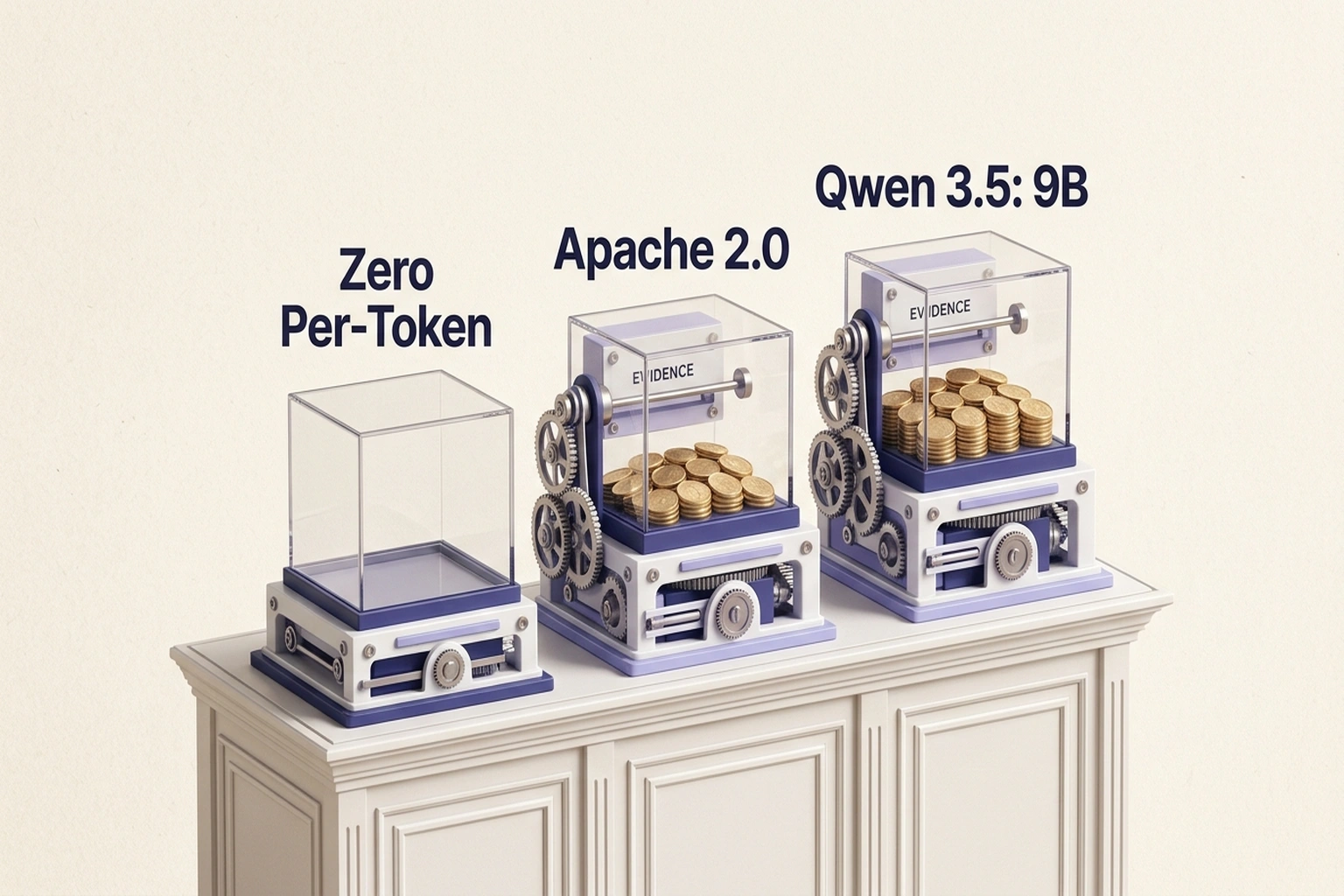
Qwen 3.5’s 9B-parameter model runs on consumer GPU hardware costing a few hundred dollars under Apache 2.0. Zero per-token cost after hardware amortization. Teams without spare GPU hardware can test self-hosted models on cloud GPU platforms like RunPod, where hourly rates let you benchmark Qwen 3.5 against API pricing before buying dedicated hardware. No capability cliff to route around. It matches models 13x its size on MMLU, HumanEval, and GSM8K , the same standard benchmarks where Nano justifies its pricing tier. Google’s Gemini Nano delivers 80–90% of large-model capability directly on-device, eliminating network latency and API dependency altogether.
But here is where this article’s own framework demands a caveat. MMLU, HumanEval, and GSM8K are precisely the kind of single-turn benchmarks that define The Two-Point Trap. No published OS World score exists for Qwen 3.5 9B. The 33-point agentic cliff that separates Mini from Nano may well exist between Qwen 3.5 and its own marketing claims , and nobody has measured it. The evidence that Qwen 3.5 “matches” larger models is drawn from the same benchmark category this article has spent 800 words arguing is insufficient. Treat those comparisons accordingly until a multi-step evaluation appears.
Kevin at Apatero argues self-hosting eliminates per-token economics entirely. But this overlooks what enterprise deployment analyses document: SLM deployments require monitoring infrastructure, governance frameworks, and compliance tooling that reintroduce operational costs the “zero per-token” framing quietly omits. The hardware may cost a few hundred dollars; the organizational overhead around it does not.
Still, the directional pressure is unmistakable. Nano’s per-token rate , a quarter of Mini’s , still binds teams to the API pricing grid. Qwen 3.5 on local hardware costs approximately zero after the GPU pays for itself. The debate about Mini versus Nano is a debate about which seat to book on a train whose tracks are being torn up. And the 33-point cliff between Mini and Nano stops mattering when the alternative has no per-token floor at all , unless the workload requires something no open-source license can provide.
Why Nano Still Wins the Compliance Stack
OpenAI has a genuine answer, and it starts with workloads nobody romanticizes. Classification, extraction, and ranking at enterprise scale , 50 million API calls per day, each single-turn, where the 33-point agentic gap is structurally irrelevant , sit squarely in Nano’s territory. Compared to the flagship GPT-5.4 at $2.50 per million input tokens, Nano delivers a 92% cost reduction. That price includes managed infrastructure, enterprise SLAs, SOC 2 compliance, and audit trails a self-hosted GPU cannot replicate without months of integration work. For a bank processing regulatory document extraction at that volume , where a failed API call triggers a compliance exception, not just a retry , the managed pipeline is not optional. It is the product.
Yet the steelman reveals its own expiration date. Classification and extraction are precisely the tasks where open-source convergence moves fastest , structured, narrow workloads where accuracy gaps narrow with every model release. Qwen 3.5’s Apache 2.0 license places zero restrictions on commercial deployment. Compliance tooling around open-source hosting , from NVIDIA’s NeMo Guardrails to enterprise Kubernetes platforms , matures quarterly. The evidence suggests Nano’s moat is switching cost, not capability. Switching costs depreciate , and building routing infrastructure for Nano-plus-Mini accelerates the depreciation. A team investing six months in a dual-tier pipeline creates organizational inertia , monitoring dashboards, on-call runbooks, classifier tuning cycles , that makes evaluating self-hosted alternatives harder, not easier, even as the economic case for migration strengthens with every release.
Calculate Before You Commit
Quantifying true small model costs demands a framework that captures both the success-rate compression and routing overhead. Apply The Routing Tax Calculator:
monthly_cost = [(nano_share × $0.20) + (mini_share × $0.75)] × (1 + routing_overhead)
Set routing_overhead between 0.15 and 0.20 to cover the task classifier, fallback logic, monitoring, and latency penalty. Then apply The Success-Rate Correction: for agentic workloads, divide each tier’s per-token rate by its OS World success rate (0.39 for Nano, 0.721 for Mini) to get the effective cost per completed task. This correction alone compresses Nano’s 3.75x token advantage to 2.03x , the gap the procurement slide never shows.
Above 80% agentic share, dual-tier pricing exceeds Mini-only cost.
| Workload Profile | Agentic Share | Verdict |
|---|---|---|
| Bulk classification / extraction | <20% | Nano , savings exceed 50%, cliff irrelevant |
| Mixed with growing agentic share | 20–60% | Mini , routing overhead erodes advantage as share grows |
| Agentic-primary pipelines | >60% | Mini or self-hosted open-source SLM |
| Edge / on-device deployment | Any | Gemini Nano or Qwen 3.5 on local hardware |
Cost of Inaction. Nano saves approximately $456,000 per year over Mini for a team processing 10 million monthly calls at published rates (assuming 1,000 input and 1,000 output tokens per call: $174,000 annually versus $630,000). But the 33-point accuracy gap on agentic tasks generates roughly 2 million additional degraded outputs per month at a 60% agentic workload. Divide the annual savings by those failures: $456,000 ÷ 24,000,000 = $0.019.
If a single degraded agentic output costs more than two cents to resolve , a retry, a human review, a downstream correction , the accuracy loss already exceeds the token savings. Two cents is not a comfortable margin. It is roughly the cost of a single additional API call at Nano’s own rate. One retry per failure and the savings are gone.
For engineers: Audit agentic share before selecting a tier:
grep -c "tool_use\|function_call" api_logs/*.jsonl | awk -F: '{sum+=$2} END {print sum/NR}'
Above 0.6, skip Nano.
For budget owners: Model the 18-month trajectory before signing annual commitments. Growth of 10 points per quarter from a 20% agentic baseline crosses the 80% break-even in six quarters , after the contract locks, per Context degradation at scale.
For platform architects: Context degradation at scale compounds the capability cliff. A routing layer adds a second, independent failure surface , two reasons for output quality to degrade, multiplying through every chained step. Evaluate self-hosted alternatives for any Nano workload where latency permits.
Limitation: these calculations use OpenAI’s published list prices. Enterprise volume discounts shift the break-even threshold, though the underlying cost dynamic remains. More fundamentally, the 33-point OS World gap , this analysis’s central claim , comes from OpenAI’s self-reported benchmark; independent verification would require a third party reproducing the full OS World suite against both models, which has not been publicly done.
Verdict
For teams running bulk classification, extraction, or ranking , single-turn tasks under 20% agentic share , Nano at its current rate remains the rational choice, delivering over 50% savings with zero exposure to the capability cliff. For everyone else, skip Nano. The 33-point OS World gap is not a benchmark curiosity; it is a failure rate that compounds through every chained step in an agentic pipeline. Teams above 20% agentic share should default to Mini, and teams above 60% should evaluate self-hosted open-source models like Qwen 3.5, where the per-token cost drops to zero and the capability cliff disappears entirely. If your agentic share is growing , and it almost certainly is , sign quarterly, not annually, and measure before you commit.
By Sam Torres
What to Read Next
- TurboQuant’s 6x Compression Creates More GPU Demand
- Qwen 3.5 Benchmark Win Hides a 15th-Place User Verdict
- Helios Turns a $400 GPU Into a Real-Time AI Video Studio
References
- OpenAI. “Introducing GPT-5.4 Mini and Nano.” openai.com
- Geeky Gadgets. “ChatGPT 5.4 Mini and ChatGPT 5.4 Nano.” geeky-gadgets.com
- ByteIota. “Small Language Models Deliver 10-30x Efficiency Gains in 2026.” byteiota.com
- Kevin, Apatero. “Qwen 3.5 Small Models Review & Benchmark 2026.” apatero.com
- Simon Willison. “GPT-5.4 Mini and GPT-5.4 Nano.” simonwillison.net
- BuildFastWithAI. “GPT-5.4 Mini vs Nano: Pricing, Benchmarks & When to Use Each.” buildfastwithai.com
- OSWorld. “Benchmarking Multimodal Agents for Open-Ended Tasks in Real Computer Environments.” os-world.github.io
- Iterathon. “Small Language Models 2026: Enterprise SLM Deployment Guide.” iterathon.tech