On March 27, 2026, the Cohere Transcribe open source ASR model posted a 5.42% word error rate (WER) on the Hugging Face Open ASR leaderboard. That score took the top spot ahead of every commercial speech recognition model on a benchmark the entire industry watches — Zoom Scribe v1, IBM Granite 4.0 1B Speech, ElevenLabs Scribe v2, and OpenAI Whisper Large v3 (Winbuzzer). Two billion parameters. Open weights. Free to self-host. A year ago, the best open-source ASR models hovered around 7–8% WER, and no open-weight model had cracked the top five on any major benchmark.
But zoom out and the picture changes. Five models now cluster within 0.5% of each other on that same leaderboard. Meanwhile, Microsoft’s MAI-Transcribe-1 claims its own “#1” on an entirely different benchmark — FLEURS, spanning 25 languages, where it posts 3.8% error (VentureBeat; Microsoft AI Blog).
Two companies. Two benchmark sets. Two victories. Neither addresses what healthcare teams actually need to deploy.
| Model | WER (Hugging Face) | Languages | Streaming | Diarization |
|---|---|---|---|---|
| Cohere Transcribe | 5.42% | 14 | No | No |
| MAI-Transcribe-1 | 3.8% (FLEURS) | 25 | No | No |
| ElevenLabs Scribe v2 | ~5.5% | ~30 | Limited | Limited |
| Verdict | Within noise | Microsoft leads | None ready | None ready |
The Benchmark Shopping Problem
Cohere points to Hugging Face Open ASR, where it leads. Microsoft points to FLEURS across 25 languages, where it leads. Artificial Analysis, an independent benchmarking service, rates MAI-Transcribe-1 at 3.0% AA-WER — fourth place, behind ElevenLabs Scribe v2 at 2.3%, Voxtral Small at 2.9%, and Gemini 3.1 Pro High at 2.9% (Artificial Analysis). Neither company mentions the leaderboard where it loses.
Call this Benchmark Picking — selecting the specific test suite that produces a “#1” claim, then treating that result as universally representative. It is not lying. It is worse: it is technically accurate and strategically misleading. When Cohere says it leads the field, it means on Hugging Face Open ASR. When Microsoft says the same, it means on FLEURS. Those statements describe different realities, and neither describes yours.
The math exposes the fragility. On a 100-word clinical note, a 0.5% WER spread amounts to about half a word. On a 1,000-word report, five words. That is not zero. But it is small enough that recording conditions, microphone quality, speaker overlap, and vocabulary mismatch can overwhelm it instantly. The leaderboard winner is determined not by model quality in the abstract but by which test audio happens to favor whose training data.
Why 0.5% Means Nothing in Production
Benchmark Picking obscures a critical gap. WER measures accuracy on clean, labeled test sets. Production audio is never clean, never labeled, and rarely resembles the test data.
Consider a clinical environment — the sector where ASR accuracy carries the highest stakes because errors create liability. A doctor says “ten milligrams of metoprolol.” A 5.42% WER model and a 5.92% WER model both transcribe it correctly, because drug dosages are high-stakes phrases where commercial models already perform well above 95%. But neither model can tell you which of three doctors in the room said it. Neither model can stream that transcription in real time to the electronic health record (EHR). And neither model can run locally on hospital infrastructure without routing audio containing protected health information (PHI) to a third-party API, per VentureBeat.
Cohere’s model supports 14 languages but lacks streaming and diarization (VentureBeat). MAI-Transcribe-1 supports 25 languages, also batch-only (Microsoft TechCommunity). These are not edge cases. They are the features that separate “demo” from “deployment.” The missing pieces map directly to actual healthcare workflows:
- Batch dictation needs high accuracy on single-speaker, structured audio.
- Live clinical conversation needs streaming plus diarization before accuracy differences even become visible.
- Security-sensitive deployment needs self-hosting or strict on-prem options before procurement can proceed at all.
A model can win the first category and still be unusable in the second and third. In batch-only workflows, WER can be the deciding variable. In multi-speaker workflows, it usually is not even the first gating criterion.
Domain-specific models already demonstrate this pattern in other regulated industries. As SLMs Are Winning the Banking Fraud War documents, specialized small models outperform general-purpose ones precisely because they focus on deployment constraints that matter — latency, locality, domain vocabulary — rather than chasing leaderboard positions.
The Convergence Neither Company Wants to Discuss
Combine the independent evaluations and a different picture emerges. Cohere leads one benchmark. Microsoft leads another. Artificial Analysis ranks both behind ElevenLabs on a third. These are independent evaluations using different methodologies — and all converge on the same conclusion: no single model dominates across benchmarks. The “best” model is the one tested on the benchmark that matches your deployment domain.
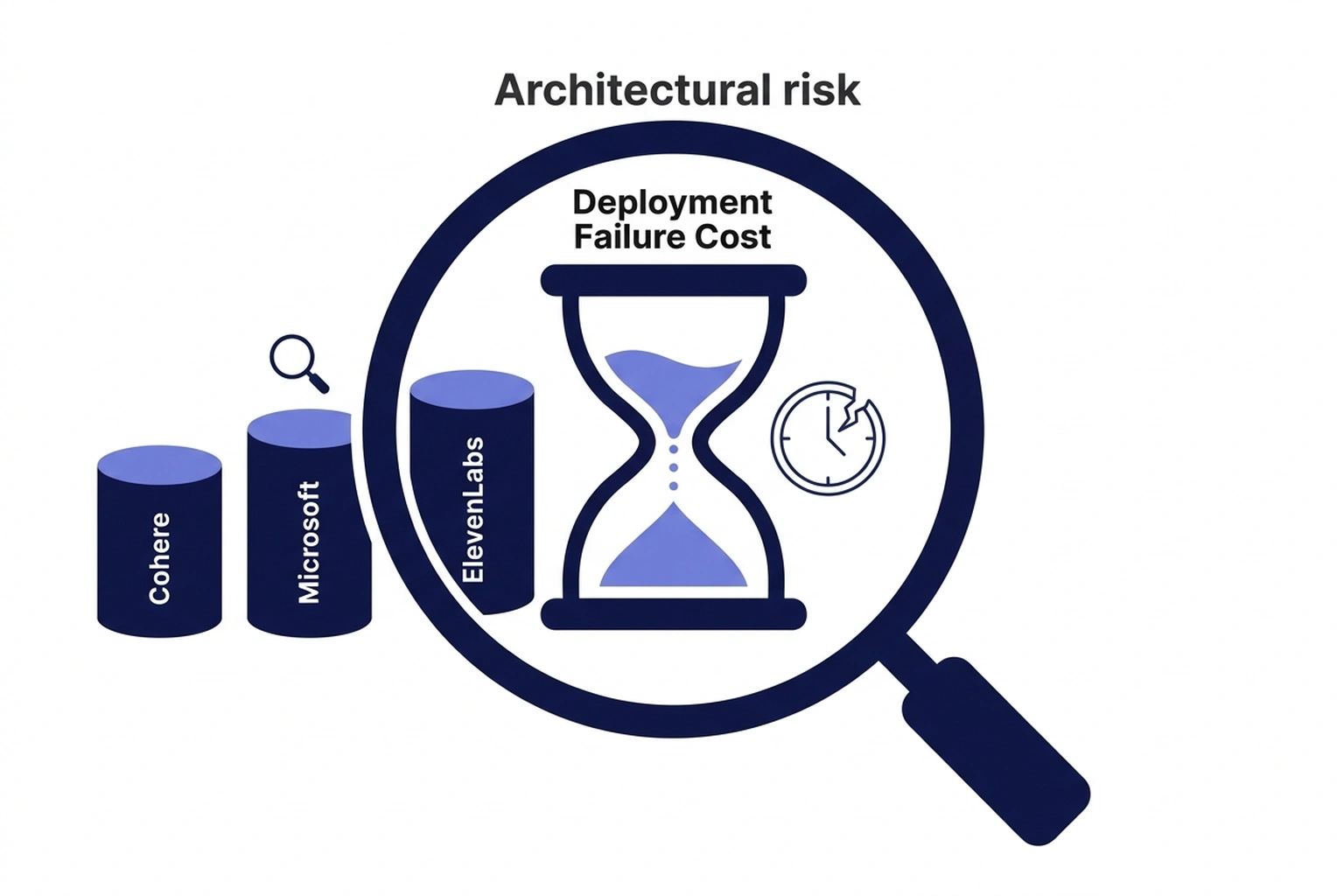
Call this the Benchmark Convergence Principle: when multiple independent evaluations disagree on rankings, the technology has commoditized. The prize is no longer accuracy. It is architecture.
Notably, the numbers make the stakes concrete. A 0.5% difference at 12,000 dictated orders per day equals 60 additional human-review events daily. Annualized across workdays, that is roughly 15,600 review events. That is the strongest pro-accuracy argument in this entire debate.
Now compare it to the architecture side of the ledger. A failed deployment costs six to twelve months and $200K–$500K in engineering rework. If the wrong model choice blocks streaming, diarization, or on-prem deployment, the organization burns a quarter-million dollars before the 0.5% WER difference ever enters the picture. That is the real comparison: tens of thousands of review events in batch mode versus hundreds of thousands of dollars and half a year of delay when the architecture is wrong. Neither side is imaginary. The buyer has to know which environment they are actually buying for, per Qwen 3.5 Benchmark Win Hides a 15th-Place User Verdict.
Here is a practical threshold test. Take your daily transcription volume and multiply by the benchmark gap. That gives you the maximum daily difference in review burden — assuming the benchmark generalizes perfectly to your audio. Then compare that number to the cost of any missing feature that blocks deployment outright. If streaming, diarization, or self-hosting is mandatory and a model lacks it, slightly better WER does not make that model better. It makes it irrelevant.
An identical dynamic appears across model categories. Qwen 3.5 Benchmark Win Hides a 15th-Place User Verdict documents a model that tops automated tests while users rank it fifteenth in practical satisfaction. Benchmarks measure what can be measured, not what matters.
The Counterargument: Accuracy Still Counts
Here is the turn the benchmark-war narrative usually misses: accuracy does still count. In some settings, it counts a lot.
In a hospital processing 12,000 dictated orders daily, every half-point of WER improvement correlates with measurably fewer pharmacist callbacks for clarification. Sixty additional errors requiring human review every day (VentureBeat). That is roughly 4.4 million dictated orders per year — enough to fill the transcription workload of every urgent care clinic in a mid-size US city.
That calculation is the best evidence in favor of caring about leaderboard deltas. If your workflow is radiology reads, pathology dictation, or discharge summaries — single speaker, quiet room, standardized format — half a point is not philosophy. It is labor. And that environment closely resembles a benchmark test set, which is exactly why benchmark WER predicts performance there.
But the same data reveals the boundary condition. In emergency departments, operating rooms, and handoff situations — where three clinicians speak simultaneously over monitor alarms — WER on clean test audio predicts much less than vendors claim. The first question in those environments is not “Is this model 0.5% better?” It is “Can this model separate speakers, stream under workflow latency requirements, and stay inside our security boundary?” If the answer is no, the benchmark gap never gets a chance to matter.
So the benchmark war is not useless. It is overgeneralized. Accuracy rankings matter inside benchmark-like workflows; architecture matters everywhere else. Once that distinction is made, most “#1 ASR model” marketing collapses into a much more honest claim: best for one slice of the problem.
Test on Your Own Audio
A practical test cuts through the marketing. Record 60 seconds of real audio from your actual deployment environment — an ICU handoff, a busy reception desk, whatever your real use case sounds like. Run that single clip through any two of the top five ASR models. Count errors yourself.
Then do one more calculation. Multiply your average words per minute by the claimed WER gap. If your clinicians dictate 150 words per minute, a 0.5% gap equals 0.75 words per minute — fewer than one word of difference in that sample. That sanity check reveals how small the benchmark spread really is before environmental variation enters the picture.
If the models produce meaningfully different results on your audio, the leaderboard might matter for your use case. If they produce equivalent results — which they will in most real-world conditions — accuracy is not your differentiator. Streaming, diarization, and self-hosting are.
Call this the 60-Second Reality Filter: one minute of your own audio reveals more about model suitability than any leaderboard. Benchmarks test general capability. Your audio tests your specific deployment conditions — your microphone quality, your background noise, your speaker overlap, your domain vocabulary. The filter does not tell you which model is best in the abstract. It tells you which missing feature will block your deployment.
This lesson generalizes beyond speech recognition. Context Rot Drops Claude to 78% Accuracy at 1M Tokens demonstrates that benchmark performance and real-world performance diverge whenever deployment conditions differ from test conditions — which is to say, always.
At present, the cost of benchmark-chasing is not hypothetical. A healthcare system that selects an ASR vendor based on leaderboard position, then discovers it cannot stream or diarize in real time, faces six to twelve months of integration rework. A mid-size hospital network processing 12,000 daily dictations that spends six months chasing the wrong model wastes roughly $350K in engineering time plus another $180K in continued pharmacist review labor — a combined cost approaching $530K. First-order: hospitals chase the top-ranked ASR model based on benchmark claims.
Second-order: they discover missing features force costly integration reworks. Third-order: those failed deployments make hospital IT departments slower to adopt any new ASR tool, widening the gap between vendor marketing and real clinical deployment. The leaderboard does not show that number. Your CFO will, per Context Rot Drops Claude to 78% Accuracy at 1M Tokens.
Stop asking “which ASR model is best” as if that were a universal question. The answer diverges by workflow. For batch dictation, benchmark accuracy may still justify vendor selection. For live multi-speaker care environments, the answer stopped mattering when five models converged within half a percentage point but still could not stream or diarize.
Start asking: Does it stream? Does it diarize? Can it run on the infrastructure without shipping PHI to a third-party API? The Cohere Transcribe model posts an impressive 5.42% WER, but any model that cannot tell you which doctor said what, in real time, during a patient handoff, is not ready for the only environment where transcription architecture — not just transcription accuracy — determines whether clinicians can use it.
Prediction: By Q3 2026, 2+ open-source ASR models will add real-time streaming and speaker diarization specifically targeting healthcare, because the current batch-mode accuracy race is commoditized and the next competitive differentiator is deployment architecture.
The Disproof Test: A peer-reviewed study showing that 0.5% WER differences on Hugging Face Open ASR predict clinically significant accuracy improvements in real-world hospital deployments — specifically, that the top-ranked model reduces pharmacist callback rates compared to the fifth-ranked model when both are deployed in identical clinical conditions. No such study exists. The absence is the finding.
References
- Cohere Transcribe Model Card — Hugging Face
- MAI-Transcribe-1: Everything You Need to Know — Artificial Analysis
- Cohere Open-Source Transcribe Model Tops ASR Leaderboard — Winbuzzer
- Cohere’s Open-Weight ASR Model Hits 5.4% Word Error Rate — VentureBeat
- Advanced Speech Recognition with MAI-Transcribe-1 — Microsoft AI Blog
- Introducing MAI-Transcribe-1, MAI-Voice-1, and MAI-Image-2 — Microsoft TechCommunity
- Microsoft Launches 3 New AI Models in Direct Shot at OpenAI and Google — VentureBeat