
Morgan Stanley eliminated approximately 2,500 positions across every division in March 2026, investment banking, trading, wealth management, and investment management, representing roughly 3% of its 82,992-person global workforce. That figure alone barely registers in an industry accustomed to cyclical trimming. What demands attention: the bank posted record annual revenue of $70.6 billion in 2025, its strongest year on record. AI layoffs on Wall Street are no longer a recession signal. They have become a byproduct of profitable quarters , what amounts to the Prosperity Cut, a structural pattern where workforce reductions accelerate during expansion rather than contraction. The Prosperity Cut rewrites the employment calculus for the entire financial sector, because it removes the one assumption mid-career professionals relied on: that strong firm performance meant job security. This report examines ai layoffs wall street.
Previous layoff cycles at major banks correlated with revenue decline or strategic failure. Citigroup cut roughly 52,000 jobs in late 2008 as the financial crisis cratered its balance sheet. Deutsche Bank announced 18,000 job cuts in July 2019 while retreating from equities trading amid years of losses. Morgan Stanley’s 2026 reduction happens during expansion, driven not by weakness but by capability surplus.
AI Layoffs Meet Wall Street’s Record Revenue
For decades, banking layoffs followed a predictable pattern: revenue drops, headcount follows. Morgan Stanley’s March 2026 cuts demolish that logic. Record $70.6 billion in annual revenue should trigger hiring rounds and bonus increases, not severance packages. Instead, the bank chose to redirect capital toward automation and AI-driven operational efficiency rather than grow its workforce. According to the Associated Press, the reductions spanned all major divisions and amounted to about 3% of global staff.
Morgan Stanley is not acting in isolation. Block CEO Jack Dorsey cut approximately 4,000 employees, nearly half the company, explicitly citing AI tools making human roles unnecessary. A Morgan Stanley AlphaWise survey of 935 corporate executives across the U.S., Germany, Japan, and Australia found that AI adoption correlated with an 11% job elimination rate alongside an 11.5% average productivity gain. Half a percentage point separates jobs destroyed from productivity created. For executives reading quarterly earnings reports, that gap represents pure margin improvement. For those displaced, the arithmetic is considerably less abstract.
The trend extends well beyond individual announcements. Bloomberg Intelligence analyst Tomasz Noetzel projects that global banks will shed up to 200,000 jobs over the next three to five years as AI absorbs back-office, middle-office, and operational roles, a roughly 3% average headcount reduction across the sector, with some institutions facing cuts as steep as 10%.
One revealing detail deserves scrutiny. Financial advisors were explicitly excluded from the reductions. Relationship-dependent, trust-intensive roles survived. Process-driven, document-heavy, and analytical roles did not. At a $70.6 billion enterprise, the sorting mechanism could not be more transparent: AI replaces workflows, not relationships. At least in this cycle.
Why “Performance Management” Doesn’t Explain This
Morgan Stanley officially characterizes these cuts as performance-based and strategically motivated, a framing confirmed by the New York Post. Standard corporate language, engineered to minimize severance complications and regulatory attention. Yet the pattern across financial services tells a sharply different story. When multiple institutions simultaneously reduce headcount during their most profitable quarters while accelerating technology budgets, “performance management” operates as a euphemism for structural replacement.
The strongest version of the counter-argument comes from economic history: every major automation wave , mechanical looms, telephone switchboards, ATMs, electronic trading , eliminated specific job categories while creating more roles than it destroyed. Morgan Stanley’s own AlphaWise survey shows an 11.5% productivity gain alongside 11% job elimination , the net is still positive, and historical precedent says that gap widens over time as new industries absorb displaced workers. MIT economist David Autor’s research has consistently shown that technology creates more employment in the long run than it eliminates. If this wave follows the pattern, the 200,000 projected banking job losses will be offset by roles in AI governance, regulatory technology, model risk management, and advisory augmentation that don’t yet appear on organizational charts.
Where that argument breaks is timing and distribution. Previous automation waves played out over decades. Loom workers’ grandchildren became factory managers.
ATM adoption took 20 years to reduce bank teller counts by 40%. AI layoffs in banking are moving at quarterly cadence , 2,500 here, 4,000 there , and the replacement roles require capabilities that most displaced workers don’t have and can’t acquire in a single retraining cycle. The historical argument is likely correct on a 20-year horizon. On a 3-year horizon, it offers cold comfort to a compliance analyst whose role just got absorbed by a workflow engine.
Skeptics will also note that 3% sits within normal annual attrition. Fair point in isolation. But standard attrition cycles backfill the positions they lose. Morgan Stanley is not backfilling these 2,500 seats. Combined with Block’s 4,000-person reduction and comparable moves across financial services, the aggregate numbers stop resembling routine turnover and begin looking like the early phase of permanent workforce contraction in knowledge-intensive finance roles.
What $70.6 Billion Buys With Fewer People
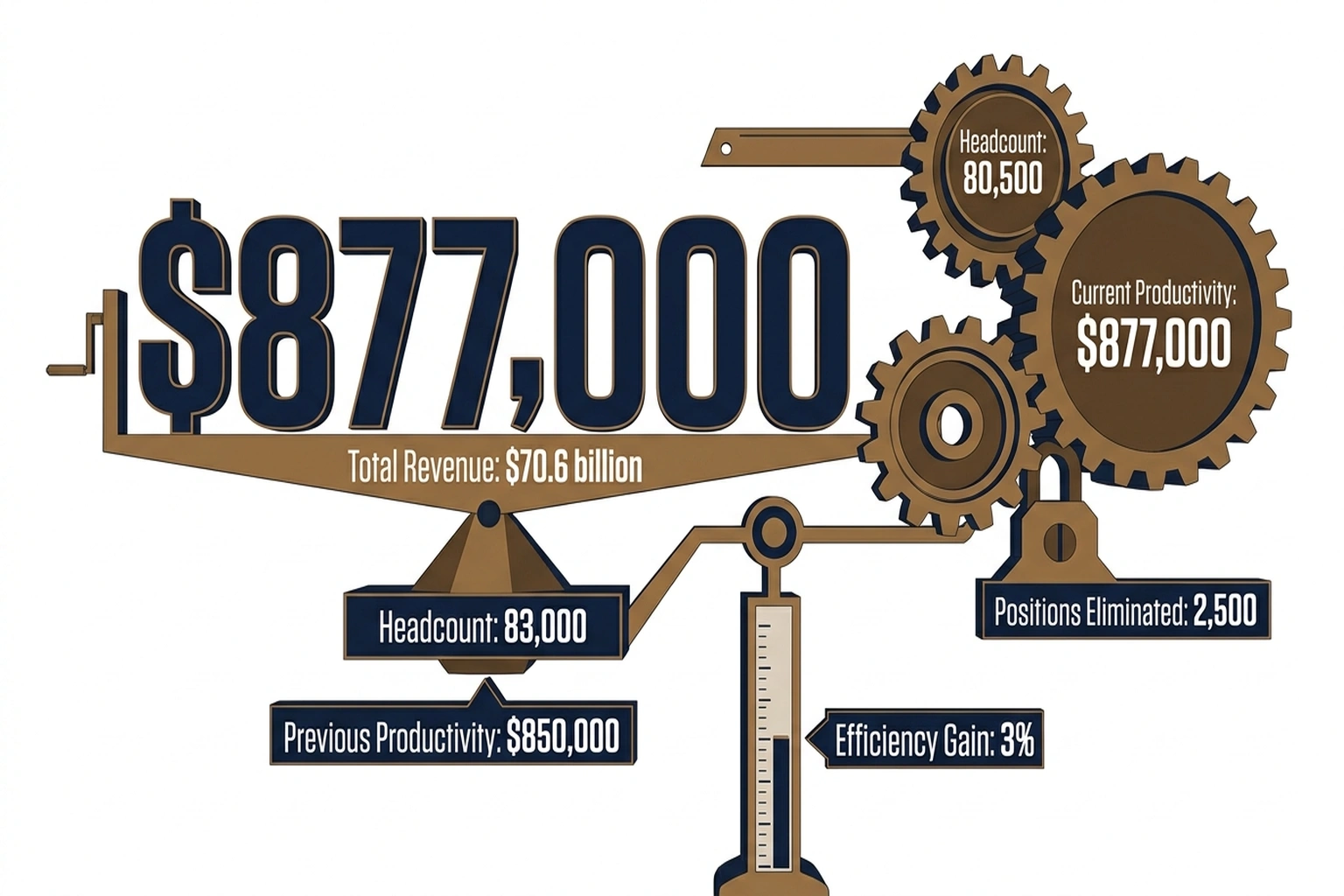
Record revenue paired with headcount reduction establishes a new operating baseline that functions like a ratchet: each profitable automation cycle locks in a lower headcount floor. Consider the arithmetic. Morgan Stanley generated $70.6 billion across approximately 83,000 employees in 2025, roughly $850,000 in revenue per employee. After cutting 2,500 positions, the bank now runs at about 80,500 heads. If it generates even flat revenue in 2026, per-employee productivity jumps to approximately $877,000, a 3% efficiency gain that flows directly to the bottom line. No earnings call rewards a CEO for reversing that kind of margin expansion. When revenue reaches $75 billion, the bank will hire for new capabilities, not to refill the roles AI absorbed.
Previous technology waves on Wall Street, electronic trading floors, algorithmic risk modeling, eliminated specific job categories while creating adjacent ones. Early evidence suggests AI automation operates differently. Trade reconciliation, regulatory reporting, compliance document processing, and routine analytical work are being absorbed without corresponding new role creation. AI-driven automation is compressing workflows across industries, and the financial services sector sits at the front of that compression wave because its core operations, pattern recognition, document analysis, rule application, map directly onto current AI capabilities. A Citigroup report found that 54% of banking jobs have high automation potential, the highest proportion of any industry surveyed.
Protected roles share one characteristic: they require contextual, trust-dependent reasoning that current AI systems handle poorly. Client advisory, strategic deal judgment, and relationship management remain shielded for now. Everything between data entry and strategic decision-making, the operational middle layer, faces displacement without a clear replacement path.
For mid-career finance professionals in operations, compliance, and back-office functions, the practical response is direct: build capability in AI system oversight, regulatory technology governance, or client advisory augmentation. Large-scale AI investment cycles are accelerating, not pausing. Waiting for eliminated positions to reappear on job boards means waiting for something that will not arrive. Within 18 months, at least three more top-ten global banks will announce similar reductions during profitable quarters. Boom-time job cuts driven by artificial intelligence are the new operating standard, not the exception.
What to Read Next
- The 30-Minute Trap: Alibaba’s AI Agent Meets Unprepared Buyers
- The 34% Problem: AI Transformation Stalls, Traps Billions
- The 80% AI Project Failure Rate Costs Firms $7.2M Each
References
- Morgan Stanley Lays Off 2,500 Employees Across All Divisions as AI Drives Major Workforce Shifts in Finance , Primary reporting on layoff scope, $70.6B revenue data, Block comparison, and financial advisor exclusion
- Morgan Stanley cuts 2,500 jobs , 3% of global workforce , New York Post via MSN confirming workforce reduction details and corporate performance framing
- Morgan Stanley to lay off about 3% of its workforce , Associated Press confirmation of cuts spanning all major divisions
- AI Adoption Surges Driving Productivity Gains and Job Shifts , Morgan Stanley AlphaWise survey of 935 executives documenting 11% job elimination rate and 11.5% productivity gain
- Wall Street Expected to Shed 200,000 Jobs as AI Erodes Roles , Bloomberg Intelligence projection of sector-wide AI-driven headcount reductions and Citigroup automation potential data
- Citigroup Announces 52,000 Job Cuts , ABC News reporting on Citigroup’s 2008 financial crisis workforce reductions
- Deutsche Bank unveils 18,000 job cuts and radical restructuring , CNN reporting on Deutsche Bank’s 2019 retreat from equities trading