6 min read · 1,474 words
This article was written with AI. It was drafted from the sources it cites and checked against the full text of those sources before publishing. How we make articles
Money is pouring into AI: private AI investment reached $344.7 billion in 2025, up 127.5% from 2024 (Source). On the buying side, TechCrunch wrote in June 2026 that “across the industry, companies are starting to balk at the price of AI” (Source).
On August 4, 2026, the Linux Foundation launched the Tokenomics Foundation with founding members including JPMorgan Chase, IBM, Accenture, and SAP (Source). When the Linux Foundation first unveiled plans for the Tokenomics Foundation in June, TechCrunch wrote that “the foundation’s first deliverable is still months away” (Source); its governing board first convened on July 30 (Source).
A Counting Instrument for a Volume Crisis
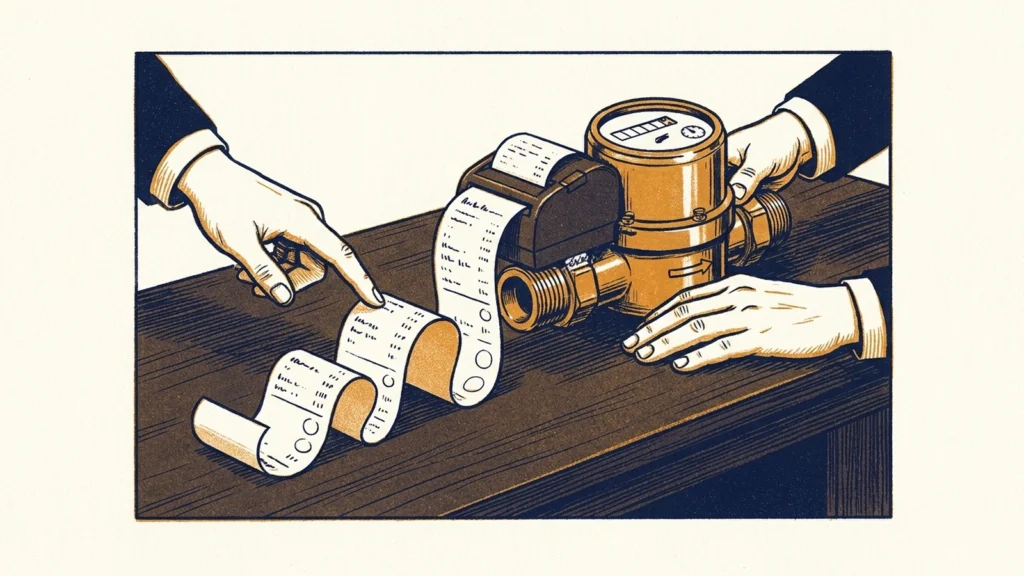
Enterprise leaders found autonomous agents consuming funds far faster than planned (Source). On this article’s reading, a billing standard would itemize spending rather than limit it. That distinction matters because the blowout was not mainly a pricing problem: per-token prices fell while the push for adoption and autonomous agents drove token consumption higher (Source). Yugal Joshi, a partner at Everest Group, told CIO that the gross AI bill keeps rising even as per-token pricing declines, and that “the same workflow ends up costing differently based on input queries and user prompts” (Source). Nicholas Arcolano, head of research at Jellyfish, told TechCrunch that expenditure on AI is exploding in large part due to agentic features, with per-developer consumption up about 18.6x in nine months (Source). Volume, not unit price, drove the overrun.
As Arcolano, head of research at Jellyfish, told TechCrunch by email: “Whether extreme spend pays off comes down to the ultimate business value of shipped code (e.g. revenue), which most companies still can’t measure” (Source). The founding roster — JPMorgan Chase, IBM, Accenture, and SAP among them (Source) — points the same way: in our reading, the effort is about billing format rather than billing limits.
Why Price Discipline Alone Misses the Volume Problem
One common framing treats the Tokenomics Foundation as overdue cost governance: TechCrunch described it as aiming to instill the same cost discipline around AI tokens that FinOps did for cloud spend (Source). That explanation sounds reasonable. It is also structurally incomplete.
When unit price falls, consumption can rise enough to raise total spending, and Everest Group’s Yugal Joshi told CIO that the gross AI bill keeps rising even as per-token pricing declines (Source). On this article’s reading, consumption volume, more than unit price, drives the bill. Variability compounds it: the same workflow can cost differently depending on its input queries and user prompts, so per-unit forecasts are unreliable when the unit count itself moves.
The founding members include banks such as JPMorganChase and BNY alongside Finout, Flexera, Vantage, Kion, DoiT, Cast.ai, Pay-i and Revenium (Source). PointFive signed on as a premier member (Source). In our reading, a coarse unit of account would make overruns harder to trace to their source, which makes granularity a political decision as much as a technical one.
The Agentic Overdraft Curve
Call it the Agentic Overdraft Curve, this article’s three-part name for what happens when autonomous call multiplication outpaces the governance meant to track it.
Capability gain. Terminal-Bench success rates jumped from 20% in 2025 to 77.3% in the 2026 AI Index (Source). On our reading, each capability gain makes agents viable for more work that was handled manually, and more viable uses mean more deployed agents consuming tokens.
Call depth. An autonomous agent can chain tool calls, sub-agent invocations, and retry loops before completing a task. TechCrunch reports that agentic tools have multiplied consumption (Source).
The two combined. The curve, as we draw it, bends upward once agent deployment outruns what budgets can absorb. That can happen well before standards bodies write the invoice format. FinOps Foundation executive director J.R. Storment told TechCrunch that in April and May he started hearing from companies saying: “Oh my god, we are 3x over our entire 2026 token budget and it’s only April” (Source).
The Governance Gap
TechCrunch’s June 2026 reporting documented enterprises working urgently to manage token costs while trying to work out whether they can salvage some return on the spend (Source). Yahoo Finance confirmed the Linux Foundation’s August 4 launch (Source). CIO reported that workflow cost variability complicates budget forecasting across deployments (Source). Roughly two months separated TechCrunch’s June 5 report and the Foundation’s August 4 launch.
Vitaly Gordon, CEO of the engineering operations platform Faros AI, offered TechCrunch an analogy: “Maybe we created a steam engine, but we still haven’t figured out the assembly line” (Source). Engine running, no brake.
U.S. private AI investment alone hit $285.9 billion, 23.1 times China’s $12.4 billion, though the AI Index notes private figures likely understate China’s state-directed capital (Source). An estimated $172 billion a year in value flows to U.S. consumers (Source). Workplace AI adoption is concentrated in technology, professional services, and finance, a former Bureau of Labor Statistics head said at a Stanford forum (Source).
What the Counterargument Misses
The strongest counterargument comes from PointFive, a premier member of the Foundation; the announcement of its membership puts it directly: “the volume of spending is not the problem enterprises are failing to solve. The problem is that nobody can locate it.” Its research puts 50-80% of a typical enterprise AI bill outside the in-platform spend controls teams rely on (Source). On that view, the meter comes first, because spend nobody can see cannot be capped.
That point is right about sequence, and it is the best case for the Foundation. It does not settle the budget, though: visibility shows where the money went without limiting how much goes. The Tokenomics Foundation’s stated aim is cost discipline through standards for measuring spend, which is not a limit on how much is spent. In our reading, a billing standard favors whoever defines the unit of account first. When the founding members define the meter’s granularity, the standard refines invoice clarity. Not consumption discipline.
MIT Sloan Management Review’s 2026 trends column expects the AI bubble to deflate, perhaps triggered by a much cheaper model or by AI spending pullbacks from large corporate customers (Source). Falling per-token prices have not stopped the overrun so far: companies were already running over budget by mid-2026 (Source).
What To Do This Quarter
The Foundation launched on August 4. The initial pieces on its published roadmap include definitions, a cost-to-serve method, value measurement, education and certification, and a reference model for the full cost of AI (Source); on this article’s reading, none of those items is a limit on spending.
Measure the burn rate tonight. Take the annual AI budget. Track monthly actuals against it. If the enterprise is consuming tokens at multiples of the planned rate, write that multiple on the first line of the 2027 budget submission. Anchor every projection to it.
Assign per-agent hard token caps this week. Inventory every autonomous agent deployment across business units. For each agent, set a monthly token ceiling. Without caps, each agent is an open pipe, which is how enterprise leaders found autonomous agents consuming funds far faster than planned (Source).
Kill the price-renegotiation fantasy. Suppose a vendor cuts per-token price by half. If agent-driven volume continues to scale multiplicatively, total spend still grows. Renegotiate price after capping volume. Not before.
Audit the ROI denominator. Without tokens-per-business-outcome as a metric, every ROI figure in the next board deck is a numerator without a denominator. As Everest Group’s Yugal Joshi put it, when the same workflow costs differently from one prompt to the next, “no CIO can make meaningful budgeting decisions or calculate RoI of such workflows” (Source).
Readiness Checklist
Score the organization. If four or more answers are YES, the team is ahead of the curve:
- Can you attribute token spend to specific agents, not just API keys?
- Do you have hard monthly token caps on every autonomous agent?
- Can you calculate tokens-per-unit-of-business-outcome for the top three workflows?
- Have you inventoried every department-level AI deployment, including shadow AI?
If three or more answers are NO, don’t wait for the Foundation’s standards: TechCrunch reported in June that its first deliverable was still months away (Source). On this article’s reading, the next budget submission is the fiscal event that matters.
Agent capabilities are rising fast: Terminal-Bench success rates have climbed to 77.3% (Source).
The Tokenomics Foundation may itemize the spend with precision. Our advice: in the 2027 budget submissions, treat any line anchored on 2026 actuals with no per-agent caps as unfinished.
References
- Stanford HAI: Inside the AI Index 2026
- Yahoo Finance: Linux Foundation Launches Tokenomics Foundation
- TechCrunch: The Token Bill Comes Due
- CIO: Linux Foundation Targets AI Cost Management
- Yahoo Finance: PointFive Joins Tokenomics Foundation
- Stanford News: Experts Clarify AI Economic Impact
- MIT Sloan Review: Five Trends in AI for 2026