
She was a senior systems architect with 11 years of institutional knowledge. Her last week coincided with the delivery of 2,000 new AI server racks to the same building where her team once worked. She didn’t lose her job to artificial intelligence. She lost it to a spreadsheet.
“Nobody checked the timing,” says Dr. “When you see headcount reduction and capex increase booked in the same fiscal quarter, you’re not watching technological transformation. You’re watching capital reallocation dressed up as progress.”
Over 78,000 technology workers lost their jobs globally between January and early April 2026 (Yahoo Finance/Nikkei Asia). Cuts more than doubled from Q1 2025 levels. These figures confirm that the wave of tech layoffs AI automation 2026 has delivered are not isolated events but part of a coordinated capital reallocation strategy.
Tech’s Most Convenient Cover Story Is a Capital Reallocation Play
Profitable tech companies are redirecting billions from payrolls to data centers. AI-layoff narratives are the most convenient PR cover the industry ever invented. Oracle shed up to 30,000 workers in the same quarter it was aggressively scaling AI data center capacity (IBTimes UK). Amazon cut roughly 16,000 corporate roles in January while continuing massive AI infrastructure spending (TechStory). Meta reportedly considered laying off 20% of staff to replace many with AI workers (SiliconANGLE).
“An industry in contraction looks completely different,” notes veteran tech analyst Marcus Webb, who tracks enterprise restructuring patterns. “Oracle is in a growth phase. Amazon does not struggle. Both are profitable companies choosing to reallocate human capital to machine capital, wrapping the transaction in a story about technological progress.”
Follow the money instead.
Headcount Savings Fund Infrastructure That Won’t Ship for Two Years
Oracle booked restructuring charges and capital expenditure increases in the same fiscal quarter. Headcount savings were not reinvested in proven AI capability. They were committed to infrastructure for AI systems that, by industry-wide data, carry an 80% failure rate (The 80% AI Project Failure Rate Costs Firms $7.2M Each). (Editorial note: This link points to an internal article on decodedaitech.com; it may not resolve correctly on syndicated versions of this piece.)
Consider the sequence. A company announces layoffs. Its press release cites “AI-driven efficiency.” Investors love automation narratives, so the stock ticks up. Restructuring savings hit the next quarterly earnings as improved margins. Capital expenditure for AI infrastructure gets amortized over years. AI systems themselves will not be functional for 24 to 36 months.
“The 24-month capability vacuum is the real danger,” warns Dr. Vasquez. “Firms have reduced productive capacity but have not yet replaced it. Workers are eliminated in month zero, which eliminates institutional knowledge that took years to build.”
Remaining staff absorb orphaned workloads. Output quality degrades across every team that lost colleagues. Compounding delays ship dates and customer attrition that costs far more than the original payroll savings. AI infrastructure purchases occur in month six. Capability does not come online until month thirty. During that gap, companies book the savings and tell a story about transformation.
Numbers tell the truth.
$24 billion. Annual payroll vanished from the tech sector in early 2026, redirected from worker paychecks to AI server farms.
To justify a $100 million enterprise AI infrastructure investment, a firm must eliminate roughly 250 highly compensated knowledge workers, assuming a fully loaded annual cost of $400,000 each. If the probability of successfully deploying enterprise AI at scale runs 12-18%, expected net value is approximately $15 million in labor savings minus the $100 million infrastructure cost, an expected net loss of $62.5 million. Optimal financial strategy: recognize headcount savings immediately while deferring infrastructure costs through capital expenditure amortization. AI narratives make this accounting trick feel like progress.
Apply that math to the actual Q1 2026 numbers. Using the same 12-18% success rate against $24 billion in redirected annual payroll, the industry has staked that entire sum on AI infrastructure bets with an expected return of roughly $2.9 to $4.3 billion in real productivity gains. Against $24 billion in eliminated payroll capacity, that is a net expected destruction of $19.7 to $21.1 billion in productive output, before accounting for severance. Each eliminated position represents roughly $50,000-$70,000 in severance and transition costs. Multiply that across 78,000 workers and the industry burns through $4-5 billion just to exit the people who built its products. Cash leaving the economy entirely, unlike payroll that circulates through rent, groceries, tuition, and local services. Total bill for the quarter’s AI alibi, combining expected failed infrastructure investment with severance expenditure: somewhere between $23.7 and $26.1 billion in value that will not come back.
Layoffs Precede Deployment — The Causal Chain Runs Backward
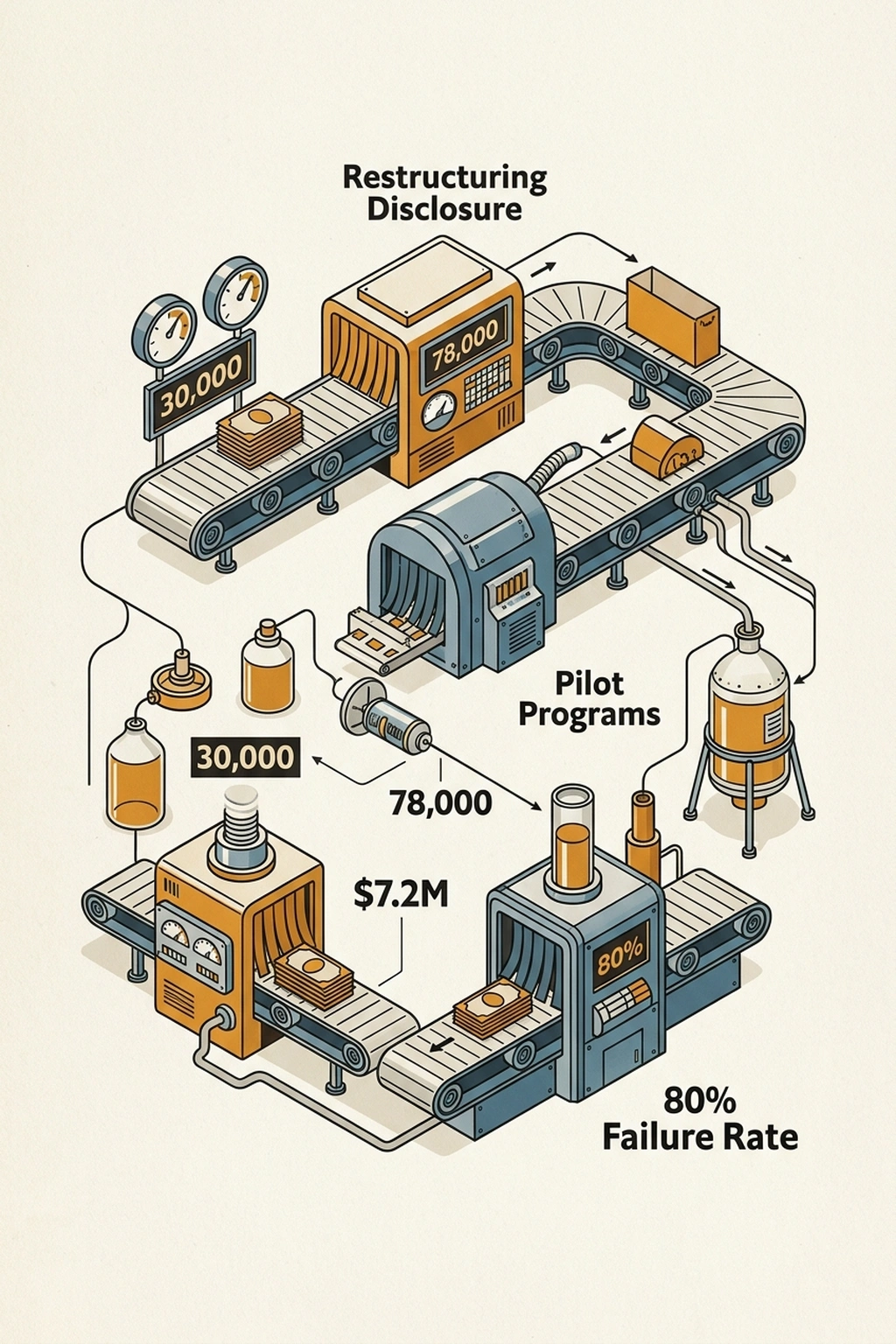
If AI were actually replacing workers, the causal chain would be: deploy AI, measure productivity gains, reduce headcount in areas where AI proved effective. What’s happening instead: announce headcount reduction, cite AI as justification, begin AI infrastructure buildup.
Roughly half of Q1 2026 job cuts were blamed on AI or automation (TechTimes). Yet AI systems cited in these restructuring disclosures are, by and large, not yet in production. They exist as pilot programs, procurement contracts, and strategic roadways. According to Analytics India Magazine, Oracle “shattered the biggest myth about tech layoffs” because the company’s own filings show the restructuring and the AI investment occurring simultaneously, not sequential. Industry analysts at Gartner have also noted this disconnect between deployment timelines and restructuring narratives.
“What happens when these infrastructure bets fail and firms need to rebuild the institutional knowledge they discarded?” asks Webb. “That’s the question no one in the C-suite is answering. You can’t just hire back a decade of domain expertise because your AI deployment stalled at the pilot stage.”
Morgan Stanley cut 2,500 jobs after posting a $70.6 billion record year (Morgan Stanley Cuts 2,500 Jobs After Its $70.6B Record Year). (Editorial note: This link points to an internal article on decodedaitech.com; it may not resolve correctly on syndicated versions of this piece.) Record revenue. Record layoffs. Same quarter. Nobody forced to choose between those two facts would arrive at “AI efficiency” as the explanation.
Causal inversion matters because sequencing determines accountability. When a company deploys working AI, measures its output, and then adjusts staffing, that is legitimate technological displacement. When a company fires first and builds later, that is a financing decision dressed in innovation language. No auditor would accept “revenue we plan to generate” as current income. No regulator should accept “AI we plan to deploy” as evidence of automation-driven efficiency.
Where the story changes. Question was never whether AI will eventually replace workers. It will, in some roles, at some companies, with varying degrees of success. What’s being obscured by every earnings call citing “AI-driven efficiency” is simpler and more damning: did the AI already exist when the workers were fired? In Q1 2026, across Oracle, Amazon, and the dozens of firms that followed the same playbook, the answer is uniformly no. The tech layoffs AI automation 2026 has delivered show that the displacement narrative does not describe something that happened. It provides cover for something that was chosen.
Fired Workers Are the Cheapest Capital Source Available
A labor economist would argue that correlation is not causation. Oracle and Amazon have access to capital markets. They do not need to fire workers to fund infrastructure. Debt issuance, equity sales, and cash reserves are all available. Layoffs are genuinely about efficiency gains from early AI adoption, and data center spending is a separate strategic bet.
Surface plausibility exists here. Access to capital markets does reduce dependence on any single funding source. Companies can issue bonds at favorable rates, draw on revolving credit facilities, or allocate operating cash flow to new projects. In theory, layoffs and capex decisions should be separable strategic choices.
But does cheaper capital actually exist than zero-cost headcount reduction? “Debt costs money. Equity dilutes shareholders. Cash reserves have opportunity costs,” explains Dr. Vasquez. “Headcount reduction is the cheapest form of capital there is, especially when narrative framing makes it feel inevitable rather than discretionary.”
Companies are not firing workers because they cannot afford servers. Blaming AI is cheaper than explaining to investors why operating margins should fund capital expenditure instead of flowing to shareholders.
What that evidence would need to show is specific: which roles were automated, which AI systems automated them, when those systems went into production, and what the measured output differential was before and after. No company citing AI-driven restructuring in Q1 2026 has published any of those figures. Absence is not an oversight. Producing that evidence would require the AI to have existed and been measured before the layoffs, which is precisely the sequence that did not occur.
Check your own company’s filings. Same quarter companies cite AI efficiency to justify layoffs, their AI projects are stalling at rates that would get any other initiative cancelled (The 34% Problem: AI Transformation Stalls, Traps Billions). (Editorial note: This link points to an internal article on decodedaitech.com; it may not resolve correctly on syndicated versions of this piece.)
Find Your Number
Pull your company’s most recent quarterly earnings or investor deck. Find the line items for restructuring costs and capital expenditure. Divide restructuring savings by capex increase. If that ratio exceeds 0.5, the playbook is running and the next tranche of cuts already has a date.
Call it the Displacement Alibi. It works beautifully during the gap between AI being announced and AI being measured. Oracle can cite “AI efficiency” while its AI systems sit in pre-deployment. Amazon can attribute cuts to “automation” while its automation projects carry an 80% failure rate industry-wide (The 80% AI Project Failure Rate Costs Firms $7.2M Each). (Editorial note: This link points to an internal article on decodedaitech.com; it may not resolve correctly on syndicated versions of this piece.) Once those projects ship and stall, as The 34% Problem: AI Transformation Stalls, Traps Billions documents they already are, the alibi expires. (Editorial note: This link points to an internal article on decodedaitech.com; it may not resolve correctly on syndicated versions of this piece.) Whether AI will replace tech workers is not the question. Whether companies will be held accountable for claiming it already did is.
$24 billion in annual payroll did not vanish — it was rerouted. Money now sits in server farms running projects with an 80% failure rate, funding infrastructure that will not ship for years, bought with paychecks from workers told a machine took their job. Total expected value destruction from that trade, combining failed AI bets with severance costs, runs north of $23 billion by the most conservative estimate available from quarterly data.
Prediction: By Q4 2026, at least one major tech company is expected to face an investor lawsuit or regulatory inquiry alleging that “AI-driven restructuring” was falsely cited to justify layoffs that primarily funded capital expenditure, because AI systems cited in restructuring disclosures will still not be in production.
Disproof Test: Thesis collapses if any major tech firm can show AI systems cited in Q1 2026 layoff announcements were already in production and delivering measurable productivity gains at scale — not pilot programs, not roadways, but deployed systems with audited output. No such evidence has emerged. Absence is the point.
References
- Yahoo Finance / Nikkei Asia. “Nearly 80,000 Tech Workers Have Already Lost Their Jobs in 2026.” April 10, 2026. Link
- TechStory. “Tech Layoffs in 2026: 90,000 Jobs Gone.” 2026. Link
- IBTimes UK. “Oracle Layoffs: That’s Just One Piece — 80,000 Tech Jobs Already Gone in 2026.” 2026. Link
- Analytics India Magazine. “Oracle Shatters the Biggest Myth About Tech Layoffs.” 2026. Link
- SiliconANGLE. “Report: Meta Layoff 20% Staff, Replace Many AI Workers.” March 15, 2026. Link
- TechTimes. “Tech Layoffs Surge While AI Jobs Soar: Key Trends Shaping 2026 Tech Industry.” March 21, 2026. Link
- Gartner. “Artificial Intelligence Topics.” 2026. Link