
8 min read · 2,104 words
Part 1 of 3 in the AI Copyright Wars series.
Six songs walked into a Munich courtroom on March 9, 2026, and the generative audio industry held its breath. “Atemlos,” “Daddy Cool,” “Rasputin,” “Big in Japan,” “Forever Young,” and “Mambo No. 5” , all allegedly reproduced by an AI trained on their melodies without a single license , now sit at the center of an AI music copyright training data lawsuit that could reshape how generative models are built.
The 42nd Civil Chamber of the Munich Regional Court heard GEMA v. Suno (Case No. 42 O 763/25) on March 9, 2026. The court expects to rule on June 12, 2026, at 10:00 a.m. in Courtroom 134 of the Palace of Justice. Whatever the chamber concludes will ripple far beyond Germany , it will test whether the text-and-data-mining exceptions that AI companies rely on can survive contact with actual music.
What GEMA Is Actually Claiming
GEMA , Germany’s collecting society representing over 100,000 composers, lyricists, and publishers domestically and more than 2 million rightsholders worldwide , filed suit against Suno on January 21, 2025. The core allegation: Suno systematically ingested copyrighted compositions to train its generative audio model, then commercially exploited the results without compensating authors.
Both parties agree on one critical fact: Suno accessed the training material on YouTube. Where they diverge is on what came out. GEMA contends that after entering simple prompts, the system generates audio in which the original works remain recognizable , matching original compositions in melody, harmony, and rhythm. Suno counters that its outputs are “not recognizable in any way” and are lawful under German copyright exceptions.
As GEMA General Counsel Dr. Kai Welp put it: “Like everyone else, providers of generative AI must respect copyright.”
GEMA is seeking injunctions, information disclosure, and damages , the same trio of remedies it successfully won against OpenAI months earlier.
The OpenAI Precedent That Changed the Calculus
Before Suno entered the courtroom, the same 42nd Civil Chamber had already set a marker. On November 11, 2025, in GEMA v. OpenAI (Case No. 42 O 14139/24), the Munich Regional Court ruled largely in GEMA’s favor, finding that ChatGPT reproduced copyright-protected song lyrics , including works by Kristina Bach, Herbert Grönemeyer, and Reinhard Mey , without licenses.
Two legal findings from that ruling carry significant weight for the Suno case.
First, the court held that embedding copyrighted material in model parameters constitutes reproduction under Section 16 of the German Copyright Act (UrhG). Drawing an analogy to MP3 compression, the court reasoned that “a model could generate statistically probable token sequences that recognisably reproduce the song lyrics on the basis of the statistical information derived during training”.
Second, the court rejected OpenAI’s invocation of Section 44b UrhG , Germany’s implementation of the EU text-and-data-mining exception. The reasoning: “permanent reproductions in the model that interferes with the exploitation rights of the authors” fall outside TDM protection. Pattern extraction is permitted; memorization is not. distinction the Extraction-Memorization Line , the boundary that will determine whether generative AI’s training economics survive contact with European copyright law. Every AI company’s training pipeline sits on one side or the other, and most cannot prove which side they’re on.
OpenAI announced plans to appeal, and the court ordered injunctive relief, disclosure requirements, and damages liability.
Why This Case Is Harder Than the OpenAI Precedent
Reproducing song lyrics is text. Courts have centuries of precedent for textual copying. Reproducing melody, harmony, and rhythm in a generated audio track is something fundamentally different, and the Suno case forces the Munich court into uncharted territory.
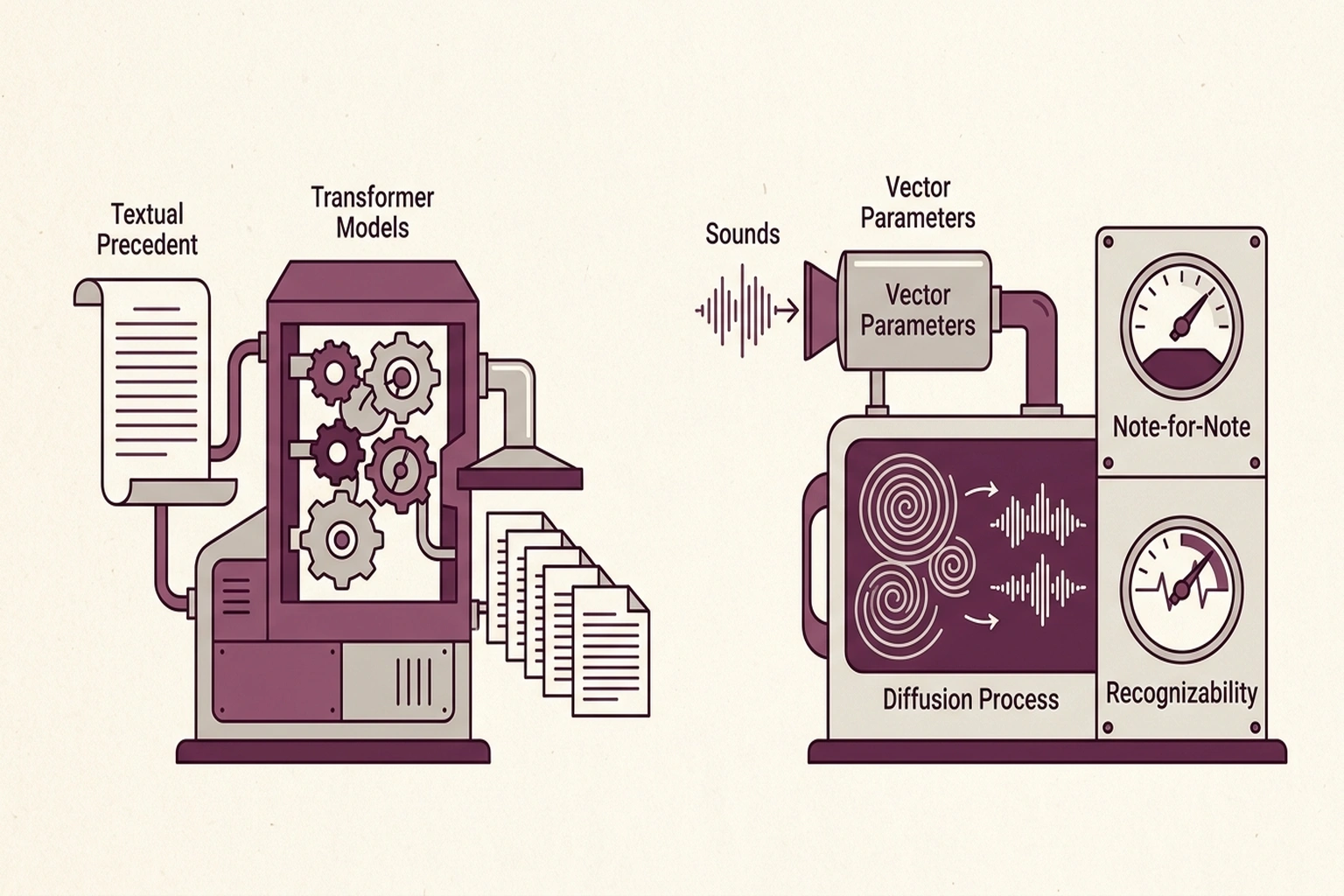
According to the Vossius analysis of the hearing, Suno’s system employs “transformer and diffusion models” that convert audio and metadata into vectors to determine training parameters. Unlike ChatGPT outputting recognizable lyrics, Suno generates playable audio from text prompts , complicating the assessment of similarity. When does a generated track “recognize” the original? Is matching a chord progression enough, or must the melody be note-for-note identical?
Suno mounts a three-pronged defense, attacking on three fronts: challenging the copyright protection of the original works themselves, questioning GEMA’s legal standing, and , most critically , disputing the similarity and recognizability of the outputs.
A further complication distinguishes this case from the OpenAI precedent: the role of YouTube’s “Rolling Cipher” technology as a potential technical protection measure under Section 95a UrhG. If Suno circumvented technical protections to access training data, that adds an entirely separate layer of infringement.
EU Copyright Law and AI Training Data Fair Use
Articles 3 and 4 of the EU Copyright Directive (2019/790) sit at the heart of every AI training copyright dispute in Europe. Article 3 creates a mandatory exception allowing research organizations to mine copyrighted data. Article 4 extends that exception to commercial actors , but with a critical catch: rightsholders can opt out through “machine-readable means, including metadata and terms and conditions”.
Notably, the EU AI Act reinforced this framework. Recital 105 explicitly confirms that text-and-data-mining provisions apply to AI training, stating that TDM techniques “may be used extensively in this context for the retrieval and analysis of such content, which may be protected by copyright and related rights.”
But the Munich court’s reasoning in the OpenAI case suggests the TDM exception has limits that the directive’s drafters may not have anticipated. Pattern extraction , learning what genres sound like, how chord progressions work , likely falls within Article 4’s scope. Memorizing and reproducing specific compositions does not. A ruling in this case will determine where exactly that line sits for audio.
For collecting societies across Europe, this distinction is existential. Austria’s AKM has already opted out its entire repertoire from commercial AI training, making unlicensed commercial training illegal under Austrian law. If the Munich court confirms that audio memorization exceeds TDM boundaries, similar opt-outs across the EU would gain immediate legal teeth.
Cross-jurisdictional comparison sharpens the stakes. In the United States, Sony Music, Universal Music Group, and Warner Music Group filed coordinated lawsuits against Suno and Udio in June 2024 through the RIAA, seeking up to $150,000 per infringing work. Those cases hinge on U.S. fair use doctrine , a four-factor balancing test with no direct European equivalent. In Denmark, collecting society Koda filed a separate lawsuit against Suno in Copenhagen City Court in November 2025, presenting evidence of unauthorized reproductions of tracks including “Barbie Girl” by Aqua. Koda cited an IFPI Denmark report estimating that AI-generated music could reduce Danish music industry revenue by 6.9 billion kroner (approximately $680 million) between 2025 and 2030 without policy intervention.
Three jurisdictions, three legal frameworks, one defendant. The German ruling on June 12 will arrive first.
Suno’s $2.45 Billion Problem
Suno is not a scrappy startup dodging lawsuits from a position of weakness. After closing a $250 million Series C at a $2.45 billion post-money valuation in November 2025, the company reported 2 million paid subscribers, over 100 million platform users, and $300 million in annual recurring revenue by February 2026.
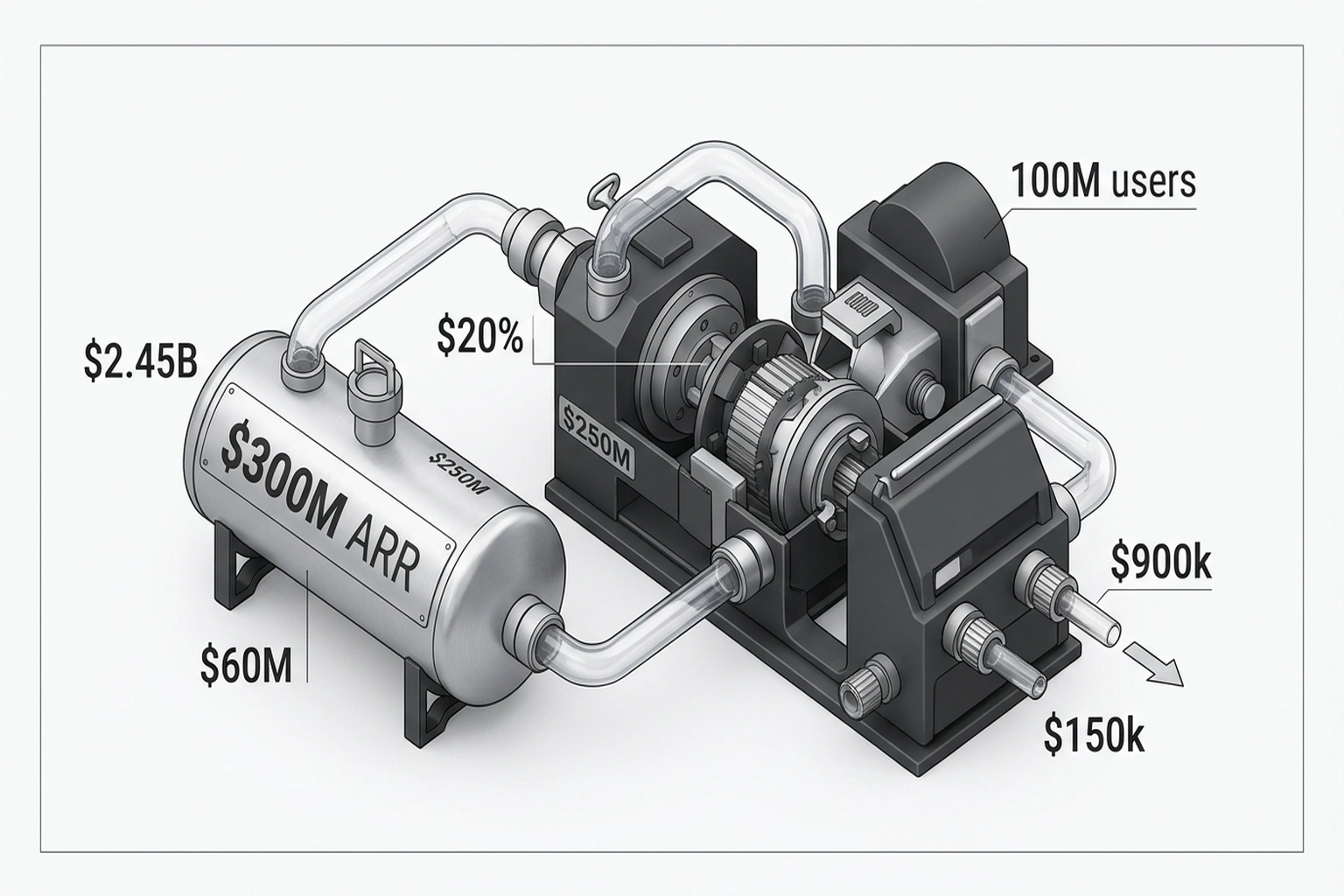
Calculate the licensing economics. Suno’s $300 million ARR on 100 million users = $3 per user per year. GEMA represents 2 million rightsholders. If the June 12 ruling requires retroactive licensing at rates comparable to streaming (roughly $0.005 per play), and Suno’s 100 million users generate an estimated 10 plays per month, the annual licensing obligation would be approximately $0.005 × 10 × 12 × 100M = $60 million , 20% of revenue. At $150,000 per infringing work (the RIAA’s U.S. statutory maximum) applied to just the six songs in this case, the exposure is $900,000. But if the principle extends to the full catalogue of works in Suno’s training data , estimated at millions of songs , the statutory exposure exceeds Suno’s $2.45 billion valuation.
Those numbers explain both why rightsholders are suing and why some are simultaneously negotiating. Warner Music settled its U.S. claim against Suno in November 2025, and Suno has hired senior music industry executives , including Paul Sinclair (former Warner exec) as Chief Music Officer, Jeremy Sirota (former Merlin CEO) as Chief Commercial Officer, and Sam Berger (former Spotify) as Senior Director of Artist Partnerships, according to Music Business Worldwide.
The parallel tracks of litigation and licensing reveal an industry hedging its bets. Labels want to establish the legal principle that training requires permission , and then monetize that permission through licensing deals. A strong GEMA ruling in June would significantly strengthen their negotiating position worldwide.
What the June 12 Ruling Could Mean
GEMA CEO Dr. Tobias Holzmüller framed the broader stakes clearly: “Europe must shape its own digital future… Only by developing our own clear standards can we safeguard the rights of our creative professionals.” That framing , European sovereignty over AI copyright norms , reveals the case’s geopolitical dimension. Suno is a U.S. company, trained on content accessed from a U.S. platform (YouTube), offering services to European users. GEMA’s lawsuit forces the question of whether copyright obligations follow the content into European markets, regardless of where the training happened.
If the court rules for GEMA, the immediate effects are threefold. Generative audio companies would need licenses before training on European repertoire , or risk the same injunctions OpenAI already faces. The Article 4 opt-out mechanism would gain real enforcement power, since collecting societies could demonstrate that ignoring opt-outs leads to court-ordered injunctions. And Suno’s U.S. fair use defense , already contested in Boston federal court , would lose any persuasive force in European jurisdictions.
If Suno prevails, the signal is equally dramatic: that the generated audio is sufficiently distinct from the source material even when trained on identifiable works, and that the TDM exception absorbs more than the OpenAI ruling suggested. That outcome would widen the gap between U.S. and EU copyright approaches rather than narrowing it.
At present, the music industry represents a test case, but the legal logic extends to every creative domain where AI trains on copyrighted works. Visual artists watching the Thaler copyright authorship dispute in the U.S. , which left AI-generated works in legal limbo , should pay close attention to Munich. Authorship and training are different questions, but a court that rules training requires a license fundamentally reshapes the economics of generative AI across all media.
Regulatory momentum is already building in parallel. The EU AI Act’s deepfake transparency requirements, strengthened after the Grok scandal, show European legislators willing to impose specific obligations on generative AI systems. A Munich ruling confirming that training on copyrighted music without licenses constitutes infringement would provide the legal foundation those regulations need.
One outcome of this case is clear regardless of who wins on June 12: the era of training first, negotiating later is ending in Europe. The question is how expensive the transition will be , and who pays.
What to Read Next
- AI Bias Audits Cost $50K. Colorado Just Killed Them.
- Trump’s 4-Page AI Framework Kills 131 State Protections
- 19 Countries, €35M in Fines, Zero AI Act Regulators
References
-
GEMA vs. Suno: German court hears landmark AI music copyright case , Music Business Worldwide. Primary reporting on the March 9, 2026 hearing, Suno financials, and GEMA executive quotes.
-
Successful Hearing for GEMA Against Suno , Vossius & Partner (IP law firm). Legal analysis of hearing arguments, specific legal provisions cited, and technical details of Suno’s system.
-
GEMA vs. OpenAI: Munich Regional Court I issues landmark copyright decision , CMS LawNow. Detailed analysis of the November 2025 OpenAI ruling, legal reasoning on memorization vs. extraction, and TDM exception analysis.
-
AI in the sights: German court sets new standards for music rights , Gunnercooke LLP. Cross-jurisdictional analysis of German ruling’s implications for Austrian and EU copyright frameworks.
-
Suno AI and OpenAI: GEMA sues for fair compensation , GEMA official page. Filing dates, specific compositions cited, and GEMA’s strategic framing of both lawsuits.
-
EU Copyright Directive 2019/790 , Articles 3 and 4 , EUR-Lex. Full text of TDM exceptions and opt-out mechanisms.
-
Record Companies Bring Landmark Cases Against Suno and Udio , RIAA. U.S. lawsuit filing details and damages framework.
-
Koda sues Suno for stealing Danish artists’ music , Koda. Danish lawsuit details and IFPI Denmark revenue impact estimates.
-
EU AI Act’s Opt-Out Trend May Limit Data Use for Training AI Models , Greenberg Traurig. Analysis of AI Act Recital 105 and TDM interaction.
“`