
7 min read · 1,693 words
On March 12, Meta quietly confirmed the Meta Avocado AI model delay: its new AI system, codenamed Avocado, would not ship in March as planned. Instead, the release slipped to May 2026 at the earliest, after internal benchmarks showed the model falling short of competitors from Google, OpenAI, and Anthropic across reasoning, coding, and writing tasks. This postponement is not a minor scheduling slip, it exposes a widening gap between capital deployed and capabilities delivered.
For a company projecting $115 billion to $135 billion in 2026 capital expenditure, nearly double the prior year, the timing stings. META shares dropped approximately 3.8% on March 14, closing at $613.71, as investors weighed a scenario few had priced in: Meta licensing a rival’s technology to bridge the gap.
Timeline of the Avocado Setback
Mapping the full sequence reveals a pattern of compounding delays and organizational disruption rather than a single missed deadline.
June 2025: Meta hired Scale AI founder Alexandr Wang as Chief AI Officer, tasking him with leading TBD Lab, an elite unit dedicated to Avocado development. Wang’s compensation package reportedly reached $14.3 billion.
Late 2025: Avocado completed pre-training, according to reporting by Techzine. Post-training, the phase that fine-tunes raw capabilities into usable outputs, proved more difficult than anticipated.
October 2025: Meta cut 600 jobs in its Superintelligence Labs, with the Fundamental Artificial Intelligence Research (FAIR) unit hit hardest. Chief AI Scientist Yann LeCun, a longstanding advocate for open-source AI, departed to launch a startup.
March 12, 2026: The New York Times reported the delay, citing sources familiar with internal testing. The planned mid-March launch shifted to no earlier than May given the scope of remaining post-training work. Some analysts flagged June as a realistic possibility.
Where the Benchmarks Fell Short
Avocado’s performance profile sits in an awkward middle ground. According to multiple reports citing internal results, the model outperforms Meta’s earlier Llama models and Google’s Gemini 2.5 (released March 2025). But against Gemini 3.0 (released November 2025), Avocado falls measurably behind in three areas:
| Capability | Avocado vs. Gemini 2.5 | Avocado vs. Gemini 3.0 | Avocado vs. OpenAI / Anthropic |
|---|---|---|---|
| Logical reasoning | Outperforms | Trails | Trails |
| Coding / software development | Outperforms | Trails | Trails |
| Writing quality | Outperforms | Trails | Trails |
| Agentic behavior | , | Trails | , |
| Verdict | Avocado clears this bar | Falls short of target | Falls short of target |
Exact benchmark scores remain undisclosed. Without specific numbers, the available evidence suggests Avocado lands between Gemini 2.5 and Gemini 3.0, a gap Parameter characterized as ranking “between” the two systems on internal evaluations. Beating a model released twelve months ago while failing to match one released four months ago is not catastrophic, but for a company spending $135 billion, it reveals what amounts to the Capex-Capability Disconnect , the gap between capital deployed and competitive position achieved. Calculate the disconnect: Meta’s $135 billion 2026 capex versus Anthropic’s estimated $8 billion total spend to date, yet Anthropic’s Claude consistently matches or outperforms Avocado. The ratio , roughly 17:1 in capital with no capability advantage , suggests that model quality scales sublinearly with spend above a certain threshold, and Meta has crossed that threshold without the organizational execution to convert compute into competitive product. These benchmark shortfalls forced the postponement to stretch into May at the earliest.
Agentic behavior deserves particular attention. According to Trending Topics, Avocado underperforms specifically in autonomous task planning and execution, the ability to chain multi-step actions without human intervention. Agentic capability has become the primary differentiator among frontier models in 2026, with Google, OpenAI, and Anthropic all shipping agent-ready systems. A model that trails on agentic tasks arrives into a market that has already moved past static prompt-response interactions.
The Gemini Licensing Question
Perhaps the most striking detail from the reporting: Meta’s AI leadership has actively discussed licensing Google’s Gemini technology as a temporary measure to power its consumer products. Facebook, Instagram, and WhatsApp, while Avocado undergoes further development.
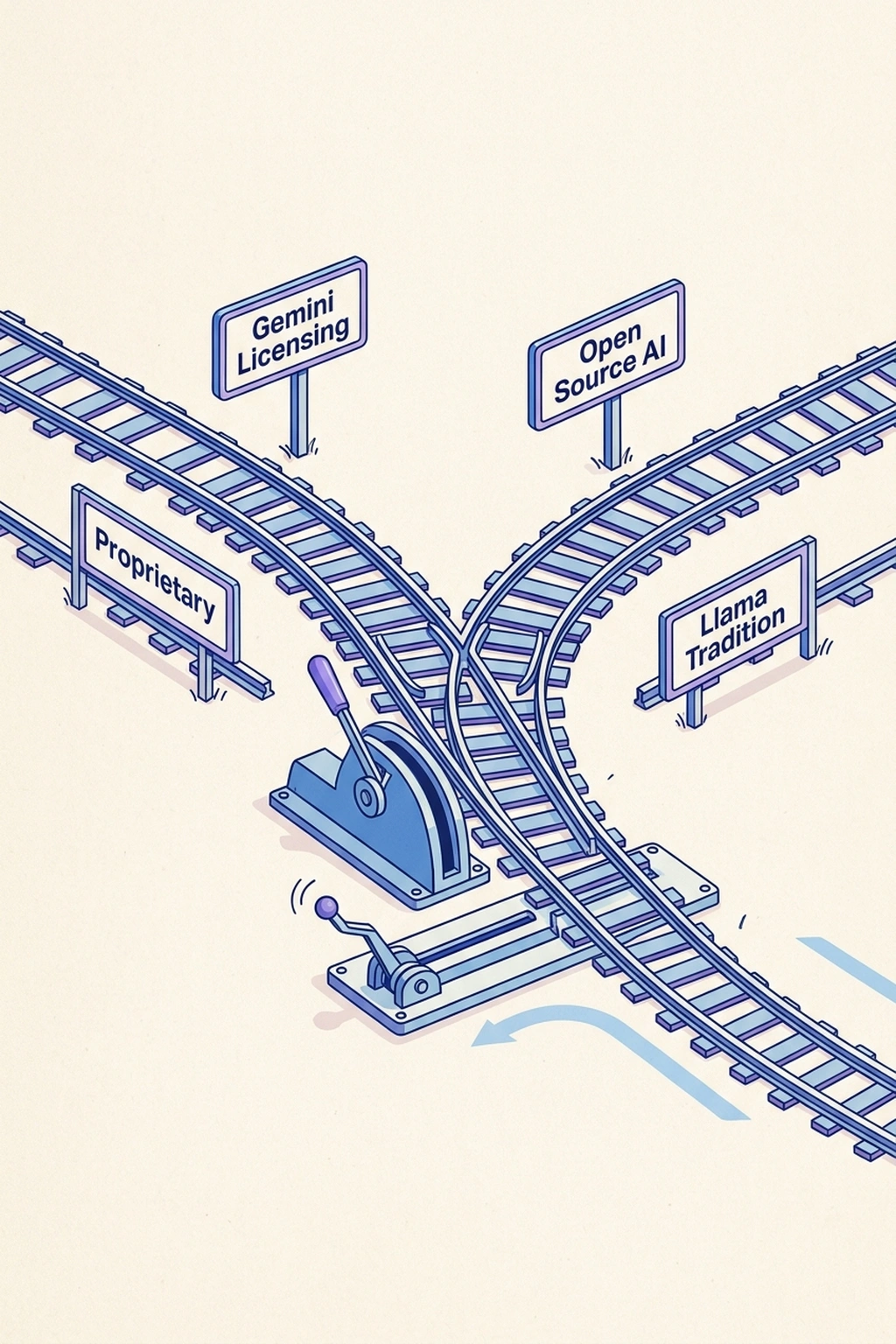
Meta has reached no final decision, but the mere consideration marks a reversal. As recently as 2024, Mark Zuckerberg published a post titled “Open Source AI is the Path Forward”. Avocado itself represents a departure from that position: a proprietary model rather than an open-source release in the Llama tradition. Licensing a direct competitor’s system on top of that shift would signal that Meta’s in-house AI capabilities cannot yet support its product ambitions.
The competitive dynamics here differ from other frontier labs. Unlike Microsoft (which resells OpenAI models through Azure), Amazon (Bedrock), or Google (Vertex AI), Meta has no cloud business to monetize AI model access. Its AI investment thesis rests on improving ad targeting, content recommendations, and assistant tools across its social platforms, a harder path to demonstrating return on $135 billion in spending.
A Pattern, Not an Anomaly
Avocado is not Meta’s first recent AI stumble. The evidence suggests systemic friction rather than a single engineering miss.
Llama 4 underperformance: Released in April 2025, Llama 4 failed to generate strong developer enthusiasm, with its flagship “Behemoth” variant delayed indefinitely due to engineering challenges.
Vibes video generation: Launched in September 2025, Vibes earned reviews as rushed to market and inferior to OpenAI’s Sora 2, missing basic features like lip-sync audio.
Organizational churn: Between Wang’s hiring, LeCun’s departure, 600 layoffs, and the reorganization of AI projects under a single division, Meta’s AI operation has undergone significant structural change in under twelve months. Internal reports describe 70-hour workweeks becoming standard within TBD Lab, a pace that may accelerate individual output but historically correlates with higher attrition and compounding technical debt.
NVIDIA CEO Jensen Huang’s remark at a recent event is telling: “We run OpenAI. We run Anthropic. We run xAI… We run them all”, a list that conspicuously omitted Meta’s Llama. Whether intentional or not, the absence reflects a perception gap. Meta has historically been a compute-heavy company training large models, yet its frontier results have not kept pace with labs spending a fraction of its budget. GPT-5.4, for instance, recently surpassed human performance on computer-use benchmarks, a capability frontier Meta has not publicly demonstrated.
What Comes Next
Meta’s official statement maintained confidence: “Our next model will be good, but more importantly, show the rapid trajectory we’re on”. Beyond Avocado, the company has a model codenamed Watermelon in development as a successor, plus Mango for high-resolution image and video generation. Lining up the next model before the current one ships is standard practice at frontier labs, but it also means engineering resources split across multiple ambitious projects simultaneously.
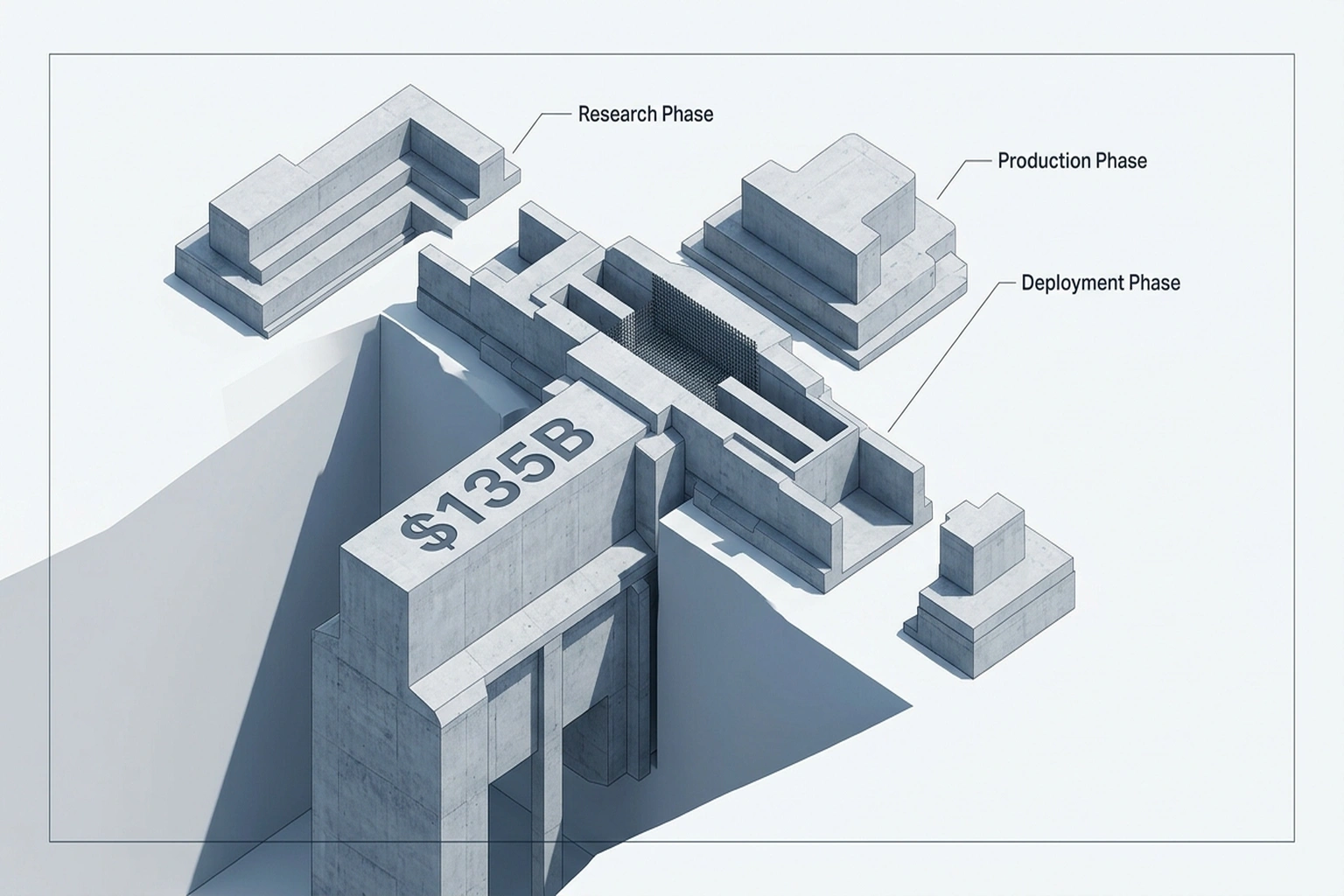
The strongest defense of Meta’s position comes from the company itself and from Wall Street analysts who argue that AI capex is infrastructure investment, not per-model spend. Meta’s $135 billion builds data centers, custom silicon, and network capacity that will serve multiple model generations , Avocado, Watermelon, and beyond. Judging capex efficiency against a single model release is like evaluating a highway construction budget based on one day’s traffic. The counter: Anthropic and OpenAI have demonstrated that smaller, more focused teams can achieve frontier capability without building their own data centers. Meta’s infrastructure bet pays off only if execution catches up to capital deployment , and three consecutive misses (Llama 4, Vibes, Avocado) suggest the problem is organizational, not computational.
A measured editorial position: Meta’s financial position remains strong, $81.6 billion in cash and marketable securities, Q4 2025 revenue of $59.9 billion growing 24% year-over-year, and Q1 2026 guidance projecting roughly 30% growth. Money is not the constraint. Execution is. And execution problems tend to compound when the organizational structure producing the models changes faster than the training cycles themselves.
China’s open-source contenders add pressure from an unexpected direction. GYM-5 demonstrated that training competitive models without NVIDIA hardware is possible, expanding the field of competitors Meta must outperform. By the time Avocado ships in May, if the timeline holds. Gemini 3.0 will be six months old, and the frontier will likely have shifted again.
Based on current trajectory, this setback could extend well beyond May. If post-training complexity was the bottleneck in late 2025, and the organizational upheaval of the past year has not stabilized, a summer 2026 release with performance landing between current Gemini 3.0 and whatever Google ships next appears more probable. Meta has the compute, the capital, and the talent pipeline. What it lacks is the model development cadence that smaller, more focused labs have established , and no amount of spending fixes that overnight. Each quarter of delay costs Meta more than the engineering time: with 3.3 billion daily active users across its family of apps, even a 0.1% improvement in ad targeting from a frontier AI model translates to roughly $70 million in incremental quarterly revenue at Meta’s current run rate. Every month Avocado sits in post-training is a month that revenue improvement accrues to competitors with shipping models.
What to Read Next
- TurboQuant’s 6x Compression Creates More GPU Demand
- GPT-5.4 Mini vs Nano: Small Model Costs Hide a 33-Point Cliff
- Qwen 3.5 Benchmark Win Hides a 15th-Place User Verdict
References
- Meta Delays Avocado AI Model , Original New York Times report breaking the story on March 12, 2026.
- Meta’s Avocado Delay Puts $135 Billion AI Bet Under Scrutiny , PYMNTS analysis of financial implications and Gemini licensing discussions.
- Meta Delays Avocado AI Model Again, Might Even License Gemini from Google , Trending Topics coverage including personnel changes and organizational context.
- Meta Platforms Stock Dips on AI Model Worries , Motley Fool financial analysis with stock data and revenue figures.
- Meta’s Avocado AI Model Delayed as Internal Tensions Rise , TechBuzz reporting on organizational churn, layoffs, and the Wang hire.
- META Stock Dips as Avocado AI Launch Pushed to May 2026 , Parameter analysis of benchmark positioning and official Meta statement.
- Meta Considers Gemini License After Disappointment With Its Own AI , Techzine reporting on pre-training completion and post-training challenges.
- Meta Delays Avocado AI Model Launch to May After Internal Testing , TinderBox coverage of Behemoth delay and Watermelon successor.