
5 min read · 1,342 words
On February 17, a company valued at $380 billion signed a three-year agreement not with a Fortune 500 enterprise or a Pentagon procurement office, but with the Government of Rwanda. The Anthropic Rwanda AI partnership, a Memorandum of Understanding covering health, education, and public sector AI deployment, is the first multi-sector government MOU Anthropic has signed on the African continent. It received a fraction of the attention directed at the company’s simultaneous legal battle with the U.S. Defense Department. That imbalance misses what may be the more consequential strategy.
What the Anthropic Rwanda AI Partnership Contains
Specifics matter more than press releases. The three-year MOU, signed by Rwanda’s Minister of ICT and Innovation Paula Ingabire and Anthropic’s Head of Beneficial Deployments Elizabeth Kelly, covers three sectors. In health, Anthropic will support the Ministry of Health’s targets for cervical cancer elimination, malaria reduction, and maternal mortality reduction. In education, the deal codifies a November 2025 pilot that provided 2,000 Claude Pro licenses to Rwandan educators and deployed Chidi, a Claude-powered learning companion built with training provider ALX, which reaches over 200,000 students and young professionals across Africa. In public sector development, government developer teams gain access to Claude and Claude Code, along with API credits and hands-on training.
No disclosed price tag accompanies the deal. Compared to Anthropic’s $30 billion Series G closed on February 12, the financial commitment appears negligible. But measuring this partnership in dollars misses the point entirely. The strategic commitment is what demands attention.
Pentagon Confrontation as Context
Eight days after the Rwanda signing, the confrontation with Washington escalated. Defense Secretary Pete Hegseth gave CEO Dario Amodei a deadline: allow unrestricted military use of Claude by 5:01 p.m. on February 27, or face consequences. Amodei refused. President Trump directed federal agencies to cease using Anthropic products, and the Pentagon designated the company a supply chain risk, the first time an American firm has reportedly received that designation. Anthropic sued the Department of Defense on March 9.
Against that backdrop, the Anthropic-Rwanda deal looks less like a side project and more like the opening move in an alternative government strategy, one that prioritizes health ministries over defense departments.
Why Rwanda Is Strategic, Not Symbolic
Rwanda approved its National AI Policy in April 2023, backed by an estimated $76.5 million in investment. President Paul Kagame has stated that AI could contribute up to 5% of the country’s GDP. Vision 2050, Rwanda’s long-term development strategy, explicitly positions the country as an East African technology hub, and the government has a track record of aggressive tech adoption, from drone-based medical delivery to cashless payment mandates.
For a company whose domestic government relationship just broke down, Rwanda offers something Pentagon contracts do not: a partner that wants AI for civilian purposes and is willing to co-design deployment frameworks from scratch.
Zoom out and the pattern sharpens. On March 10, Anthropic announced a Sydney office, its fourth in Asia-Pacific after Tokyo, Bengaluru, and Seoul. Australia ranks fourth globally in Claude usage relative to population, with enterprise customers including Canva, Commonwealth Bank of Australia, and Quantium. On February 25, the company acquired Vercept, a computer use startup co-founded by Kiana Ehsani, Luca Weihs, and Ross Girshick. International infrastructure, technical talent acquisition, and government partnerships in allied democracies and emerging markets: these moves describe a company building outside the U.S. defense orbit while maintaining $14 billion in annual run-rate revenue.
Government-First AI Diplomacy as Business Model
Conventional AI industry strategy treats defense contracts as the crown jewel of government revenue. OpenAI, Palantir, and Scale AI have pursued Pentagon work aggressively. Anthropic’s refusal, and subsequent blacklisting, appears to violate that playbook entirely.
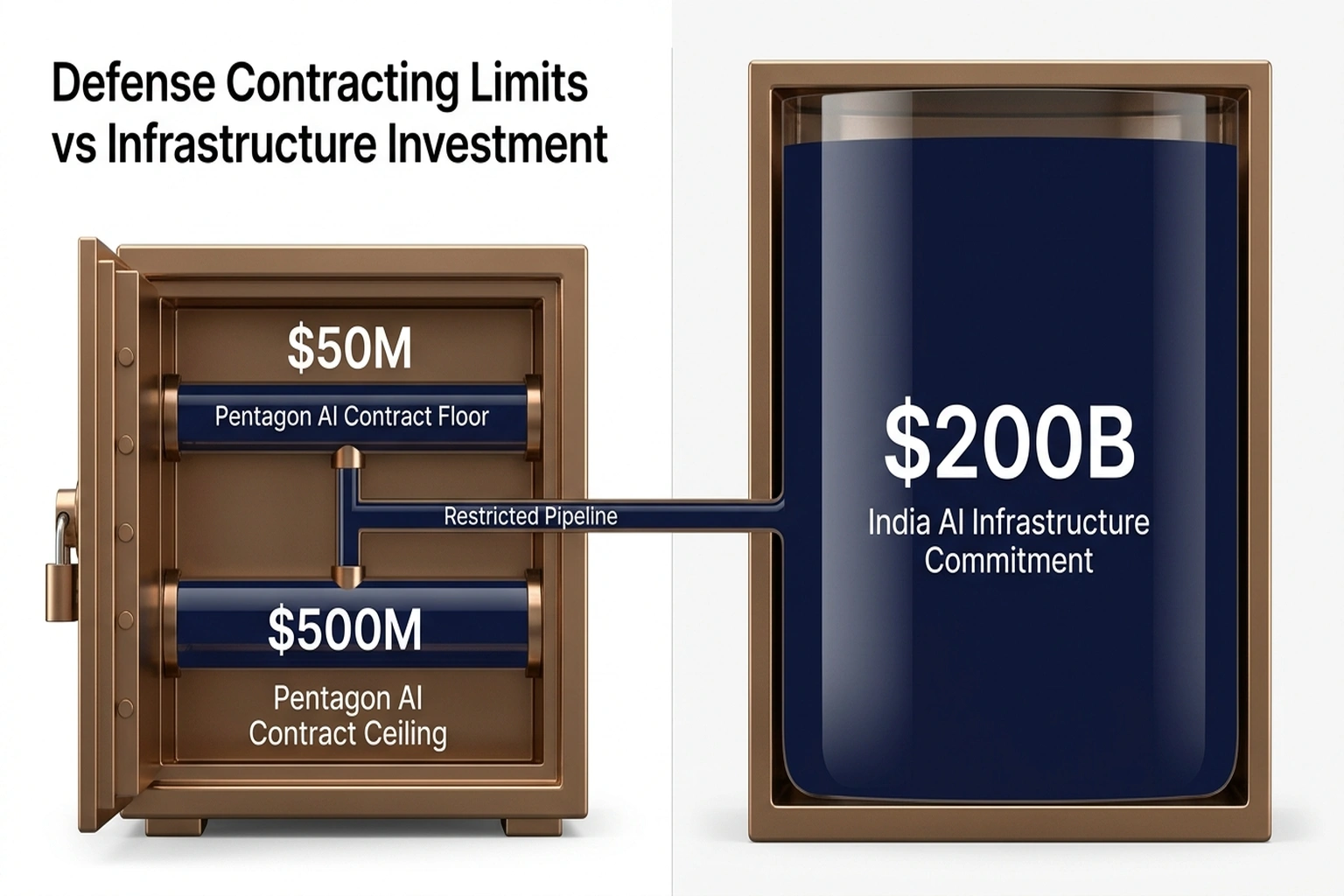
But the This collaboration tests a different thesis , what amounts to the Diplomacy Arbitrage: government-first deployment in emerging markets and allied democracies may generate more durable value than restricted military contracts. Deployment data from Rwandan health workers tracking malaria cases, or from teachers using Chidi across eight African countries, produces broadly applicable evidence of AI benefit in public services, evidence that transfers to India’s $200 billion AI infrastructure commitment or Australia’s national priority sectors.
Run the numbers on the Diplomacy Arbitrage. Pentagon AI contracts typically range from $50-500 million over 3-5 years but come with ITAR restrictions that prevent commercial reuse of any deployment data or models. Rwanda’s MOU likely costs Anthropic under $10 million in API credits and staff time, but the deployment evidence , health outcomes, educational metrics, developer adoption , transfers directly to commercial pitches in India, Brazil, Nigeria, and Indonesia. Combined addressable government AI spending across those four markets alone exceeds $18 billion by 2028. Based on the calculations in this analysis, a $10 million investment generating transferable evidence for an $18 billion addressable market represents an 1,800:1 use ratio. No Pentagon contract offers comparable commercial optionality.
The counterargument is straightforward: defense contracts provide recurring revenue with contractual certainty, while emerging-market MOUs are non-binding and subject to political risk. Palantir’s $1.8 billion in government revenue demonstrates the model works. But Palantir’s government revenue is 55% U.S. defense , a concentration risk that the supply chain designation episode just made visible to every AI company watching.
As the DOGE 120-character ChatGPT prompt episode demonstrated, government AI adoption without institutional capacity building produces failures. Rwanda’s model, training thousands of educators, building developer capacity, piloting before scaling, represents what this analysis considers the inverse approach.
Cost of inaction for AI companies ignoring emerging-market government partnerships: every quarter of delay is a quarter where a competitor establishes the reference deployment. Once Rwanda publishes health outcome improvements from Claude-assisted malaria tracking, that evidence becomes Anthropic’s sales collateral for every health ministry on the continent. The first-mover advantage in government AI diplomacy is not revenue , it is the deployment data that makes every subsequent deal easier to close.
A position worth stating plainly: this analysis argues the partnership is more strategically important than the Pentagon lawsuit. A legal dispute over military AI restrictions has a binary outcome. A three-year deployment generating real-world health and education data across an emerging market creates a replicable template. By 2028, at least two other frontier AI companies are likely to formalize similar government MOUs in Africa or Southeast Asia, not from altruism, but because deployment evidence from healthcare AI in under-resourced settings will prove more commercially transferable than classified defense applications. Kigali, not the Pentagon, is likely where the next chapter of AI diplomacy gets written.
What to Read Next
- The 30-Minute Trap: Alibaba’s AI Agent Meets Unprepared Buyers
- The 34% Problem: AI Transformation Stalls, Traps Billions
- The 80% AI Project Failure Rate Costs Firms $7.2M Each
References
-
Rwanda signs MoU with US AI company Anthropic across health, education, public sectors , Anadolu Agency coverage of the three-year MOU covering health, education, and public sector AI deployment in Rwanda.
-
Anthropic partners with Rwandan Government and ALX to bring AI education to hundreds of thousands of learners across Africa , November 2025 education partnership details, including 2,000 Claude Pro licenses and Chidi deployment across eight countries.
-
Anthropic Revenue Run Rate Climbs to $14 Billion Amid India Push , Yahoo Finance reporting on Anthropic’s $14 billion annual run-rate revenue and enterprise growth trajectory.
-
Anthropic closes $30 billion funding round at $380 billion valuation , CNBC independent reporting on the Series G round and investor details.
-
Sydney will become Anthropic’s fourth office in Asia-Pacific , March 2026 Sydney expansion, Claude usage rankings, and named enterprise customers.
-
Anthropic Acquired Seattle AI Startup Vercept , Dataconomy coverage of the February 2026 acquisition, including co-founders Kiana Ehsani, Luca Weihs, and Ross Girshick joining Anthropic.
-
Will the Pentagon’s Anthropic controversy scare startups away from defense work? , TechCrunch coverage of the Hegseth ultimatum, supply chain designation, and broader defense-tech implications.
-
The National AI Policy of Rwanda , Rwanda’s April 2023 AI policy framework, estimated $76.5M investment, and GDP impact projections.